Artificial Intelligence has been used to create videos of what purports to be Agatha Christie giving a series of writing lessons for budding writers, using Agatha Christie’s own written and spoken words – see the link below. It would be interesting to know whether Lucy Foley and Sophie Hannah, who have been producing new stories featuring Miss Marple and Hercule Poirot respectively, have watched them.
I have yet to; I did once start to write a story featuring the first meeting of Captain Hastings and Miss Lemon (after Poirot’s funeral) – it had a working title of The Code of Miss Lemon. I thought it was about time that they actually met on the page rather than just on the screen, but I couldn’t really get it to work. Maybe with a bit of Swigatha’s advice to hand I’ll give it another go.
Here is a summary of Christie-related on free-to-air UK TV during the festive season. Everyone hopes that the highlight will be the new version of Murder is Easy. For those who enjoy debating which Poirot was the best, three different versions of Murder on the Orient Express will be showing within 5 days of each other …
CHRISTMAS DAY 15:10 Death on the Nile (Peter Ustinov) BBC2 21:50 Murder at the Vicarage (Joan Hickson) BBC4 22:30 Murder on the Orient Express (Suchet) ITV3
BOXING DAY 04:10 The Cornish Mystery* (Suchet) ITV3 10:55 Hercule Poirot’s Christmas* (Suchet) ITV3 16:00 The Moving Finger (Hickson) Drama 20:00 Why Didn’t They Ask Evans? (H Laurie) ITV3
DECEMBER 27 07:35 Dead Man’s Mirror (Suchet) ITV3 13:50 Lucy Worsley biography 1/3 BBC2 14:50 The Mirror Crack’d (Lansbury) BBC2 16:35 Evil Under the Sun* (Ustinov) BBC2 21:00 Murder is Easy 1/2 (NEW) BBC1
DECEMBER 28 13:30 Lucy Worsley 2/3 BBC2 14:30 Witness for the Prosecution (Wilder) BBC2 16:25 Murder on the Orient Express (Finney) BBC2 17:25 The Mirror Crack’d … (Hickson) Drama 21:00 Murder is Easy (2/2) BBC1
December 28 at 14:30, BBC2
DECEMBER 29 13:30 Lucy Worsley 3/3 BBC2 16:50 The Body in the Library (Hickson) Drama 20:00 Murder on the Orient Express (Branagh) More4
DECEMBER 31 17:40 A Pocket Full of Rye (Hickson) Drama
There is a positive riot of Agatha Christie on UK TV over the holiday period; it is becoming a Christmas tradition. A Christie for Christmas? Just slightly! It is almost impossible to list everything which is on, but here are some highlights to give a flavour of it, with two obvious stand-outs.
SUNDAY, 23rd DECEMBER CHANNEL 5 9:00 pm Agatha and the Truth of Murder This is a new drama related to Agatha Christie’s infamous eleven-day disappearance in 1926. The story imagines that she faked her own disappearance to investigate a true-life murder: that of Florence Nightingale’s god-daughter … Sounds intriguing!
ITV3 Agatha Christie’s Poirot 4:25pm Dumb Witness 6:45pm Hercule Poirot’s Christmas – in which Poirot rescues Japp from his family Christmas 9:00pm Murder on the Orient Express
MONDAY 24th DECEMBER ITV3 Agatha Christie’s Poirot 3:00pm The Theft of the Royal Ruby … in which Poirot displays his talent for peeling a mango (which David Suchet had learned from the Duke of Edinburgh) 4:00pm Dead Man’s Folly … filmed at Greenway, Agatha Christie’s holiday home 6:00pm The Big 4
BOXING DAY, 26th DECEMBER BBC 1 9:00 pm ABC Murders part one The big event swigatha-wise over Christmas. Some purists have already slammed it without seeing it – and understandably so, given previous adaptations by the same team. Like those, this one has a strong cast and is a must-see, even though the verdict might be ‘never again.’ Parts two and three are at the same time, on the 27th and 28th December.
ITV3 Agatha Christie’s Poirot 4:45 pm The Affair at the Victory Ball 5:55 pm The ABC Murders … helpfully scheduled so that viewers can go from this old version (1992) to the new one and still have time to have supper in between. If there is a scene on BBC that lives up to the one below then we are in for a treat:
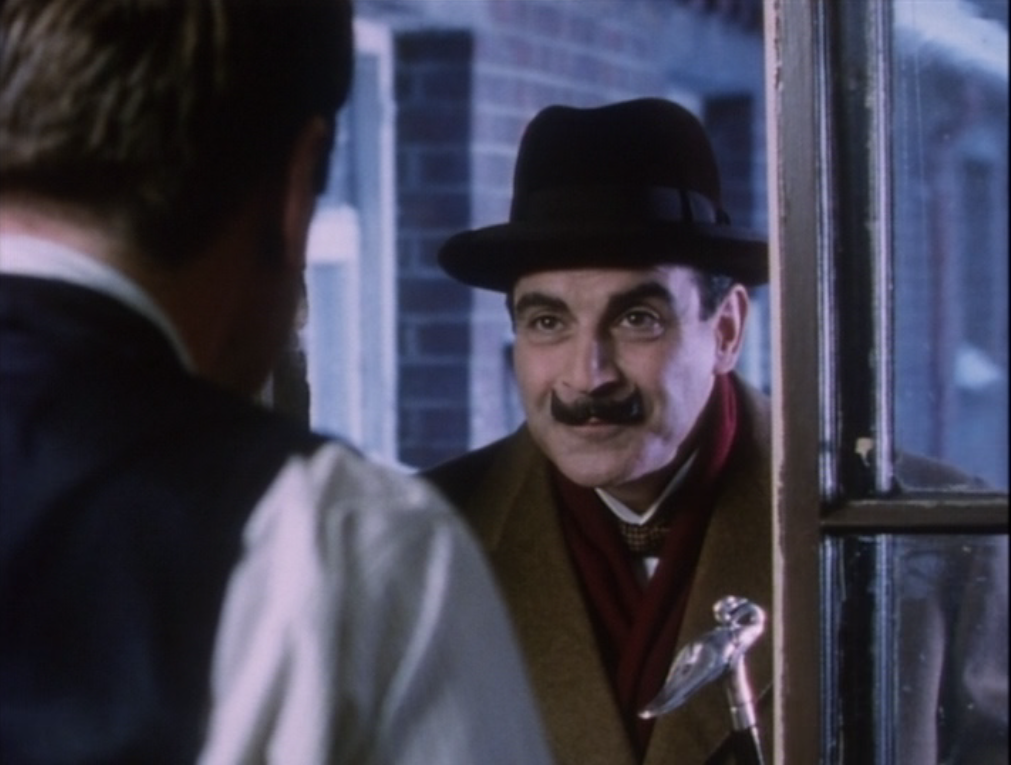
In gaol: Donald Sumpter as Cust and David Suchet as Poirot
FRIDAY, 28th DECEMBER CHANNEL 5 6:00 pm Crooked House A repeat of last year’s Christmas offering. It was tucked away on Channel 5, so many may have missed it. Worth a re-look.
Also on this day, and on subsequent days, ABC Murders continues on BBC1 and ITV3 goes in for an orgy of Suchet’s Poirot, with at least three films each afternoon, including Curtain (28th December) and Evil Under The Sun (29th). There are eight hours of it on New Year’s Eve alone. Neither the BBC Radio Times nor the ITV3 website lists all these episodes.
NEW YEAR’S DAY ITV3 8:25 am Murder on the Orient Express The first, and in my opinion, best adaptation of this brilliant story; made in 1974, it features Albert Finney and his (to Agatha) disappointingly unflamboyant moustaches. I find it amusing that, 45 years later, Agatha’s fans still respond to the appointment of a new Poirot, most recently Kenneth Branagh and John Malkovich, based on the evidence of his upper lip. I suspect she would have hated Suchet’s plastic monstrosity and quietly admired the chutzpah of Branagh’s. 2:50 pm Agatha Christie’s Marple: At Bertram’s Hotel 4:55 pm Agatha Christie’s Marple: Ordeal by Innocence A somewhat misleading series title. Agatha Christie’s actual Marple never appeared in this book 7:00 pm Agatha Christie’s Poirot: The Adventure of the Clapham Cook One last outing for Suchet’s Poirot before he collapses on the sofa with exhaustion.
Four months after the death of Hercule Poirot, his friend and associate Captain Hastings is contacted by Poirot’s solicitors and given a letter from the dead man*. When Hastings has recovered from the shock of its contents, they ask if he will help them, for a fee, to tidy up some of Poirot’s business affairs. Hastings, at something of a loose end, agrees, and travels to the flat in Whitehaven Mansions for a meeting with Miss Felicity Lemon, Poirot’s one-time secretary.
In order to help Hastings set Poirot’s papers in order, Miss Lemon realises that she will have to explain to him her filing system, which had finally reached the state of perfection of which she had always dreamed. This explanation might take some time…
The filing system contained and cross-referenced all the information about every case that Poirot had solved – each clue, each motive, each suspect, each alibi and each murderer.
Also filed away were all of Poirot’s notes for his unpublished masterwork, ‘The Criminal Psychology‘. Hastings decides that he will put these notes into some kind of order and get them published as a tribute to his old friend. He realises that that will also take some time, and so he decides to rent the flat while he works on it.
Miss Lemon then shows Hastings a pile of unanswered correspondence from people wishing to consult Poirot, unaware of his recent demise. Now, Miss Lemon has been out of a job for four months, and Hastings has a brain-wave: he invites her to become his own personal secretary, and she agrees.
His first instruction to Miss Lemon is to contact the landlord of the flat and enquire about a lease. His second is that she should reply to each of the letters, informing the correspondents that Poirot is dead, but that his long-time associate Captain Hastings is available should they wish to consult him instead.
As Miss Lemon types away furiously, there is a tap on the door. It is Inspector Japp….
NOTE
*See the final chapter of Curtain, by Agatha Christie
ITV’s Poirot series ran from 1989 to 2013, and by its conclusion had covered just about every novel or short story featuring the Belgian detective that Agatha Christie wrote. The series was, and continues to be, hugely popular, and the face of David Suchet as Hercule Poirot is one of the most instantly-recognised faces anywhere in the world.
When the series began, it concentrated on the early short stories featuring Poirot as a consulting detective based at Whitehaven Mansions in London, with his associate Captain Hastings, secretary Miss Lemon and Inspector Japp, an old sparring partner from Scotland Yard. These programmes were each just under an hour long, and perfect light-hearted fare for Sunday nights. When the producers turned their attention to the full-length Poirot novels, where possible they would try to shoe-horn Japp, Hastings and Lemon into the story whether they had appeared in the original or not.
This continued to be the case until 2003, by which time the producers realised that the series had become just a trifle tired and formulaic. A decision was made to concentrate on Poirot working on his own, as had been the case in most of the original books anyway.
A New Start
The first programme in this new format was an adaptation of Five Little Pigs, a storyin which Poirot is commissioned by Lucy Lemarchant to investigate the murder of her father sixteen years (fourteen in the film) previously, a crime of which her (now-deceased) mother Caroline had been convicted. Lucy had only been a small child at the time, but Caroline had written a letter to her protesting her innocence – a letter withheld from Lucy until she reached the age of 21.
Poirot agrees to investigate the past, and talk to those also present at the time of Amyas’ death. They are Philip and Meredtith Blake, Elsa Greer, Miss Williams and Angela Warren – the five little pigs.
The resultant film proved to be a triumphant vindication of the producers change of direction.
True to the Original
Five Little Pigs is not the easiest novel to televise, consisting as it does of five characters reminiscing verbally, and then in writing, to Poirot about the events of many years before. During the course of the book nothing else happens, there are no fresh incidents or crimes to spice things up, there are no humorous interludes. This is a dark tale and Poirot is almost a minor character.
There must have been a great temptation to add extra elements of drama or humour to the story, as the series had often done, but the producers resisted here, with one exception: Caroline Crale is hanged for murder, rather than quickly dying in prison.
This addition meant that the production could concentrate on stressing the tragic nature of what had happened and describing the haunting impact it still had on those who were present at the time. It achieves this by using strong character actors to bring depth to each of the main protagonists, by the use of different styles of camerawork and lighting to depict the past and the present, and by the careful choice of music to illustrate the tragedy of the Crale family.
What is most unusual about this particular Poirot episode is that some elements of it are so subtle that they only become obvious on a second or third viewing. Someone clearly took huge care with this production. Here are some examples from the screenplay, the music, the filmwork and the casting.
The Alice Blue Gown
Although Poirot’s novel career lasted from 1920 – 1969, the TV episodes were typically set in 1936. The events leading up to the murder of Amyas Crale would therefore have occurred in the early 1920s, and the costumes and sets reflect this.
The film begins with a seven-year-old Lucy winding up a record player and playing a new ’78 before dressing up in one her mother’s dresses and joining her parents on the terrace.
This is a scene from an apparently idyllic summer, but by the end of it both the parents are dead and Lucy herself sent to live with relatives abroad.
The record Lucy plays is “Alice Blue Gown”, recorded in 1920 by Edith Day. ‘Alice Blue’ was a particular colour favoured by Alice Roosevelt, daughter of the American President, and all the rage at the time; it is also the colour of her mother’s dress that Lucy tries on.
Fourteen years later, the same song is playing in the background as the Five Little Pigs make their way to a re-union at the scene of the crime. Lucy digs out the same dress from her mother’s old dressing-room to wear before she goes downstairs to confront them.
This level of attention to one small detail, introduced right at the start and then again at the end, surprised me. Not once in the film, even at the end, is any explicit mention of the dress made by anyone, nor is any indication of the song’s title given. It is only as a result of re-watching Five Little Pigs that I even noticed it.
The Music
The theme music for the Poirot series was composed by Christopher Gunning, and for most episodes cases all of the incidental music as well.
For Five Little Pigs, however, this was not the case. Apart from ‘Alice Blue Gown’, and an excerpt from the Love Duet from Tristan and Isolde, there is the haunting piano music of Erik Satie (‘Gnossienne No 1‘): ¹
I asked Chris about its inclusion:
“I didn’t choose the piece. It was chosen by the director because he liked it, but he only suggested it for one section. I then suggested we use it in various other sections so as to provide continuity and varied the orchestrations to be suitable for those additional sections. I was happy with this, because I also loved the piece. I thought the result made for a more interesting score overall than some other episodes – I also only used the “famous” theme right at the end.”
This is an inspired choice of music because, alongside the film-work, it manages to underline the feeling of loss of each of the main characters – whether the loss of innocence, or family, or the only person that they ever loved .
Chris composed two other main themes for the film – Amyas Crale’s Last Painting, and The Innocence of Caroline Crale, which is interlaced with the Satie piece throughout. ²
The Filming
The story encompasses three periods – the seemingly idyllic childhood summer holidays of the Crales and the Blakes prior to the First World War, the more obviously idyllic but ultimately fateful summer of the early 1920s, and the darker summer of the mid-1930s, during which the truth is allowed to reveal itself. Each of these periods is filmed differently.
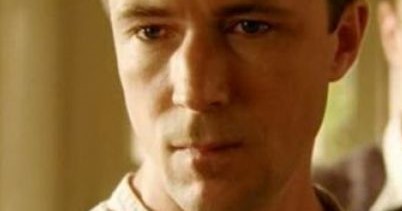
The childhood sequence is somewhat fuzzy, like a silent home movie. It is slightly disturbing, hinting at the conflicting emotions of the four young people even then. The fuzziness also has the effect of allowing the young ones to closely resemble their older counterparts.
Amyas Crale as a boy…
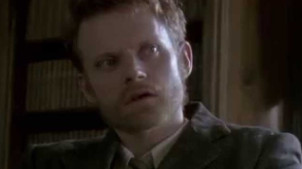
Meredith as a boy …
… and as a man
… and as a man
As the five little pigs recollect their memories of the fateful events of the 1920s, the flashback filming is done by hand-held camera, giving the impression to the audience that they are also witness to events, or even filming it themselves.³ The atmosphere is light and airy throughout, almost hazy, including the sequence when Amyas is killed: maybe that is a reflection of the hazy nature of the little pigs’ memories.
By contrast, the later sequences featuring Poirot, his interviews and explanation, are all fully-focussed and sharp, and almost uniformly stark and colourless. The little pigs have aged by fourteen years but no make-up is needed to illustrate the passage of time.
This bleakness underlines how much each character has been haunted by the events of that long, hazy summer fourteen years previously, and how each of them has lost something then that they can never hope to reclaim. There is no ‘closure’ in this film.
Liberties taken
You can never have an Agatha Christie adaptation without the producers thinking that somehow they are going to be able to improve on the original.
The main change to the original is shown right at the start – the hanging of Caroline Crale (in the book she dies in prison). The rest of the film takes place almost in the shadow of this event. Every time Caroline is remembered, often accompanied by her own theme music, it is more poignant because we already know what lies in store for her.
I doubt whether Agatha Christie would have approved of the hanging, but I am sure she would have snorted somewhat at other, somewhat petty changes: the events described taking place fourteen, rather than sixteen years previously; the child Carla’s name being changed to Lucy; Elsa’s age being reduced to 18, and Caroline’s failure to seduce Philip, rather than the other way round.
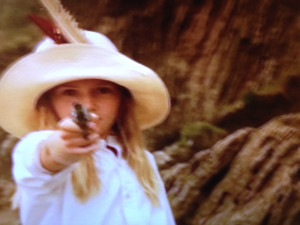
The other major plot change occurs at the end, when Lucy pulls a gun on the criminal after Poirot has revealed all. This is unnecessary, and goes against the grain of the rest of the film, but even here the way had been paved: there is an earlier sequence that shows Lucy as a child playing Cowboys and Indians with her young aunt Angela, who is encouraging Lucy to shoot her (“That’s the whole point!”).
In neither case does Lucy pull the trigger.
Lucy, wearing the Alice Blue gown, takes aim ...
Lucy, as a child, takes aim
And Finally…
Even the ending is haunting.
In the final sequence, after Poirot has explained all, Lucy, still wearing her mother’s Alice Blue gown, turns her back on everyone and wanders through the shroud-bedecked hall of her old home back into the past – onto a sunlit terrace and into the arms of her parents once more. In the background, Gunning’s orchestration of Satie plays; it is not until the credits begin rolling that his Poirot theme is quietly and seamlessly introduced. Perfect.
In spite of a couple of needless ‘enhancements’, I think that this is the finest adaptation of any Poirot story that I have yet seen.
Selected Cast and Crew
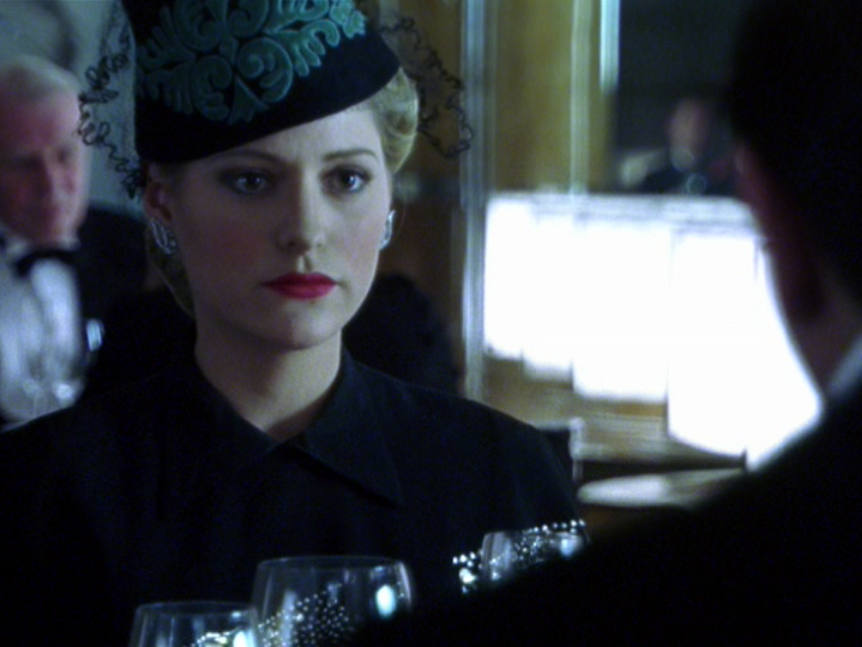
AIMEE MULLINS (Lucy Crale) AIDEN GILLEN (Amyas Crale) RACHAEL STERLING (Caroline Crale) TALULAH REILLY (Young Angela) DAVID SUCHET (Hercule Poirot) TOBY STEPHENS (Philip Blake) JULIE COX (Elsa Greer / Lady Dittisham) MARC WARREN (Meredith Blake) GEMMA JONES (Cecilia Williams) SOPHIE WINKELMAN (Angela Warren)
KEVIN ELYOT Screenplay MARTIN FUHRER Cinematography CHRISTOPHER GUNNING Music PAUL UNWIN Director MARGARET MITCHELL Producer
NOTES
¹ This is the piece playing at the top of this review. Recorded for Swigatha by the pianist Chris Long http://www.chrislongmusic.co.uk/ THANKS!
² I had originally included (with Christopher Gunning’s blessing) a snatch of his incidental music for this film, for a nominal fee agreed with the publisher. Then extras were added that made this too complex and expensive, so the link has been removed (with great reluctance!).
³ There is an excellent interview with the producer Margaret Mitchell that accompanies the DVD edition of Five Little Pigs, included in the box set of all 9 of the ITV Poirot series.
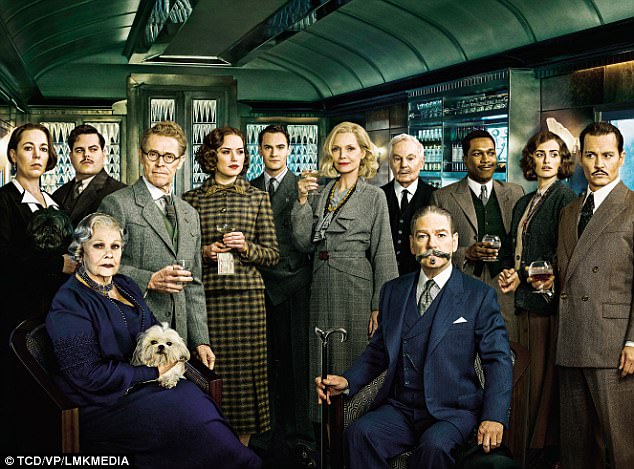
Swigatha went to the ‘movies’ to check out the new version of Murder on the Orient Express. To say it has had a mixed reception in the press and on social media is to put it mildly – people either seem to love it or get bored by it. Of course, they are reviewing it as a blockbuster film, with loads of ‘stars’ in it (and rather more biffing than is in the book).
As such, the group of six I went with all enjoyed it, even if some were bewildered by how Poirot solved it. This is a much darker film than the lusciously-produced, all-star 1974 version. It is far more in keeping with the David Suchet version for ITV.
Their overall rating was – pretty good, with fine performances from Daisy Ridley, Derek Jacobi and Branagh himself, and a very good one from Michelle Pfeiffer as the ‘leader of the gang’, Mrs Hubbard.
Does it swig?
I of course was judging it as an adaptation of Agatha Christie, as an exploration of one of the finest plots she invented. The film’s outline plot is the same as the one in the book, but the actual motive behind the events – a group of 12 people appointing themselves as both jury and executioner – is never really explained. The actual clues (including the important one that enabled Poirot to guess the identity of the victim) are all too often quickly passed over to make space for fatuous sub-plots that have nothing to do with it.
Here is one example. Right at the beginning, Poirot is entreated to resolve a dispute between the Muslim, Jewish and Christian priests based in the Church of the Holy Sepulchre in Jerusalem. He does so in sub-Cumberbatch-Sherlock style by using his stick to entrap the real villain, who is of course the person that asked him to intervene in the first place.
For the rest of the film, Poirot spends more time assessing his breakfast eggs (one of the few attempts at humour in the film) than hinting to his partner M. Bouc (and us) what is going on. The pace of the whole film feels wrong, and the thrills and changes of character brought in to pander to the supposed tastes of modern audiences just don’t work or make sense. The story is about 15 people who get stuck in a railway carriage for a few days with no way out – all they can do is talk, and the truth is revealed in what they say and how they say it. Not in this film.
Who are these guys?
Every adaptation of a book for a film should be allowed some leeway with its depiction of the characters, but this one goes too far:
The aristocratic diplomat Count Andrenyi from the book appears here as a kick-boxing (in 1934!), ballet-dancing diplomat in this film. He literally kicks Poirot out of his bedroom.
The high-minded Colonel Arbuthnot of the book appears as a sharp-shooting doctor who not only wounds Poirot in the shoulder to ‘warn him off’, but also stabs Mrs Hubbard, the ‘jury’s forewoman’, in the shoulder for reasons which escaped me.
The character of the Swedish nurse, for which Ingrid Bergman won her Oscar in 1974, has been replaced by a Spanish nurse named Pilar Estravados. I suppose it allowed Penelope Cruz to take part. As an aside, Pilar Estravados actually was a character from a swigatha – but not this one; she appears in Hercule Poirot’s Christmas.
Conscience makes a coward of Poirot
When Poirot revealed the solution, both in the book and in the 1974 film, there was a wow factor: readers and viewers realise they should have seen it coming a mile away, but somehow didn’t.
The denouement in this film, however, has no wow-factor, because the predominant reaction is: “How on earth did he work that one out?” Too many of the characters and their motives are undeveloped and clues are not properly explained.
The dilemma then for Poirot is whether to let them get away with something that is as justifiable an act of revenge as could be imagined. His mantra, however, had always been that once you have open your heart to murder, and get away with it, you will most likely do it again, if only to prevent the truth coming out.
In the book, he propounds two solutions and leaves the decision as to what to tell the authorities to M. Bouc, his partner and the Director of the Line. In this film, on the other hand, he tells the killers that his conscience will not allow him to cover up their actions; they may as well kill him before the police arrive. He hands them a gun to test their reaction. Mrs Hubbard instead turns the gun on herself – and finds it is unloaded.
This reaction persuades Poirot that they are not really killers, so he propounds his alternative solution to the police when the train finally arrives at Brod station. He then leaves the train, only to be apprehended at the station by a British diplomat who begs him to help investigate a death on the Nile.
I fear a franchise coming on…
Swigatha Rating
… but I don’t think Branagh’s efforts justify it. It’s a decent enough film, and I have a huge respect for him as actor and director, but the whole point of a swigatha is the who-dun-it bit: the unusual setting, a mysterious, impossible murder, clearly-delineated clues and suspects, and a famous detective who makes sense of it all.
In this case, the individual suspects and clues were not clearly-delineated at all, and by the end I don’t think most of the people in the cinema CARED who’d dun it. For an adaptation of an Agatha Christie book, that just isn’t good enough.
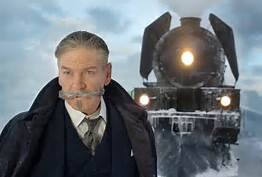
On the bright side, Agatha Christie would have loved Branagh’s moustaches.
2017
Kenneth Branagh’s film version of Murder on the Orient Express will go on general release in November 2017. The previews have been available for a while. Branagh’s portrayal of Poirot, complete with luxurious moustaches, has already attracted a great deal of (not always complimentary) comment.
It is likely that he has chosen, deliberately, to distinguish himself as much as he could from previous manifestations of Poirot to make a role of his own. Having heard the voice he uses on the preview, I think he will succeed, as indeed did the two actors in the previous films of the book.
1974 and 2010
There have been two fine versions of the story already – one for the cinema, directed by Sidney Lumet in 1974, and one for ITV’s Poirot series (2010).
The film was was more or less faithful to the plot and the atmosphere of the book; it was a huge success (at the time the top-grossing British film ever) and is repeated often on TV. The ITV production team were keenly aware that their own efforts might be overshadowed by comparisons with it.
They set out to make a version that had a very different atmosphere, and in doing so created something that was more or less faithful to the original plot, but which questioned some of the attitudes and assumptions within it. It is very much a 2010 take on a book written in 1934.
What is interesting to me is that the actual story stands up incredibly well for itself in both cases. This blog will examine the differences between the two versions, and, in anticipation of the new film, speculate about what tricks it might have up its sleeve. But first, here is a resumé of the book’s plot and one aspect of the character of its main protagonist, Hercule Poirot.
Murder on the Orient Express – the original story Hercule Poirot is recalled urgently to London from Istanbul and finds that the first-class carriage is fully booked. The director of the line, M Bouc, finds a bunk for him, to the consternation of most of the other passengers. One of them, named Ratchett, tries to hire his services en route, but Poirot turns him down because he (literally) doesn’t like the look of him.
During the night, the train is held up in a snow-drift as it makes its way to the Yugoslavian town of Brod. In the morning, Ratchett is found murdered in his cabin. It is clear that no-one could have entered or left the train, and that the killer must still be in the carriage. Ratchett had been stabbed twelve times.
Poirot is asked by Bouc to investigate and come up with a solution to present to the local police when they eventually get to Brod. He soon finds out that Ratchett’s real identity was that of the notorious gangster Cassetti, who had kidnapped and murdered the two-year-old Daisy Armstrong 5 years previously. Casseti had escaped conviction on a technicality, having used his connections to bribe the legal authorities.
There are twelve other passengers in the carriage, as well as the conductor. It soon becomes clear that every one of them has a connection with the Armstrong family, and that they had plotted this bloody revenge, in effect acting as judge and jury to effect it. The conspirators had gone to great pains to leave clues that threw suspicion on a supposed gangster associate of Cassetti. Unfortunately for them, the extreme weather conditions had rendered this alternative solution implausible, because he could not have got on or off the train as they had planned it.
Poirot, however, presents this solution, and the actual one, to M Bouc, and allows him to choose which one to present to the Yugoslavian police. M Bouc, in the interests of ‘natual justice’, but also in the interest of his line’s reputation, decides to present them with the evidence that points to a fugitive gangster.
Poirot retires from the case, and goes to his cabin to wrestle with his conscience.
The Justice of Hercule Poirot
Hercule Poirot describes himself as ‘un bon catholique‘ who ‘does not approve of murder’. He does not always seem to approve of the legal justice system either.
In many of his cases, he stops short of bringing the culprit to justice. He gives them instead the option of taking their own way out, presumably by committing suicide, although that word is never mentioned. He does so in order to spare them, or their loved ones, the horrors of what was inevitably to come: trial and the hangman’s rope. In one example, Poirot performs the execution himself.
The Murder on the Orient Express is the only example where he lets the killer(s) get away with it completely. This at odds with his often-expressed conviction that, once someone has allowed evil to enter into their heart, and committed murder – no matter what the provocation – they will probably do it again.
This possibility – that, having got away with it once, the conspirators might strike again – is ignored by the book and the 1974 film, but is very much present in the 2010 TV programme.
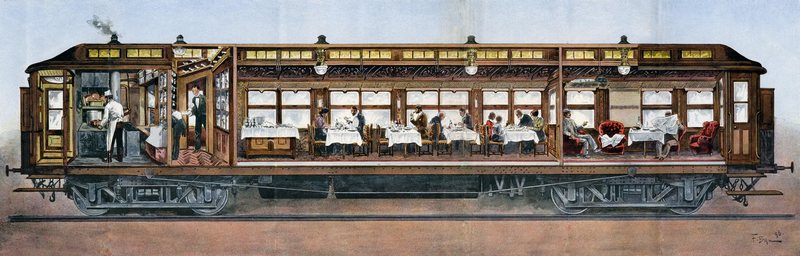
Murder on the Orient Express – the film This film has an all-star cast, with many headlining actors seemingly content to play minor, almost stereotypical roles. The setting is luxurious, with the atrocious weather conditions outside seeming to have no effect on the comfort of the passengers and crew.
Albert Finney is a believable Poirot, even if a very young one (he was 38). He plays it for laughs quite a bit – in fact, most of the cast do. Jokes are added. Vanessa Redgrave, in the role of Mary Debenham, spends the whole film in a wry state of amusement at what is happening around her.
The star turn is undoubtedly Ingrid Bergman, as Greta Ohlsson, one-time nursemaid to the Armstrong household. She is only in one main scene, but absolutely fills the screen during it. It is a very moving performance of a simple woman who turned to religious devotion to help her cope with the aftermath of Daisy’s murder. The film was nominated for 6 Oscars but she was the only winner (for Best Supporting Actress).
The film follows the plot very closely, and when Poirot presents his two solutions and Bouc selects the false one, no-one seems bothered, least of all Poirot. The champagne is brought out and the killers all toast each other. The message is loud and clear: justice has been done, and twelve murderers are free to make their way home.
Agatha Christie was pleasantly surprised by the film (her last public appearance was at the premiére) because so many adaptations of her books had produced dreadful results. Even so, she did not like Albert Finney’s moustache: ‘I wrote that he had the finest moustache in England — and he didn’t in the film. I thought that a pity — why shouldn’t he?‘ Maybe that explains Branagh’s overblown affair…
Murder on the Orient Express – the TV programme When I first saw the TV programme, I was disappointed. There was far too much emphasis on the supposed ethical dilemma that Poirot faced and religious elements obsessing both him and the other passengers on the train. Having re-watched it, I realise that I had missed the point.
Whilst not tampering with the books plot, the screenplay certainly tampered with its lenient attitude towards the conspiracy: it can never be justified that a group of people should elect themselves judge and jury and mete out their own version of justice.
To make that clear, Ratchett is transformed from a homicidal sadist to a God-fearing man hoping to atone for his crimes and seeking penance, and the righteous Colonel Arbuthnot has to be stopped from killing Poirot when it looks like he is about to betray them to the local police. In this version, Arbuthnot has allowed evil to enter into his heart.…
To hammer the point home further, the programme begins with the stoning to death of a woman by a mob in Istanbul, witnessed by Poirot, Arbuthnot and Mary Debenham. The victim was pregnant with another man’s child. The horrified onlookers are powerless to intervene, and Poirot says that it is best not to: the woman knew the rules, she knew what she was doing and she knew what would happen to her.
Similarly, Ratchett had also known what he was doing and is now all too aware of what probably lay in store. While he is being executed he is all too conscious, as the poor woman had been, of the first blows that are struck by those pursuing mob justice.
The focus of the rest of the film is on whether Poirot will allow them to get away with it. He does, just, but his logical mind tells him that they are no better than those casting the stones. Whether Arbuthnot and Debenham, who alone have witnessed both deaths, come to the same conclusion is doubtful.
Overall, this is a much darker version of the story (literally). As the train is held up in the snowdrift, its facilities and comforts become unavailable to the passengers. There is no running water and they are forced to sit in semi-darkness to await their fate. This is all a splendid contrast to the fun and frolics of the film, and there is no hint of self-congratulation at the end.
Finally
The moral of the TV film reminds me of a wonderful passage from Tolkien:
There is no trace of pity for the victim in the book or the 1974 film (Agatha Christie would have been horrified if there was), but the audience might feel some when watching the TV film.
It will be interesting to see which version of the story Branagh’s will most resemble. Maybe he will produces something very different, with Poirot delivering the murderers to justice… My suspicion is that it will be a mix of the two – an all-star cast with an equivocal portrayal of the morality displayed by their characters.
Like many of Agatha Christie’s stories of the 1940s, A Murder is Announced is set firmly in the time that it was written (1947-9), with every character in it affected in one way or another by common features of the post-WW2 period in the UK: the rationing of everything, and the difficulties of finding one’s way and place in a hugely-changed world, whether as a refugee, demobbed soldier, ex-land girl or whoever.
Underlying the story, however, there are also elements driven by the angels and demons of the author’s own childhood that add hugely to its quality.
A combination of the two creates a picture of a village way of life (in Chipping Cleghorn) that is unrecognisable from that described in her earlier stories.
Village Life in King’s Abbott
Dr James Sheppard, the narrator of The Murder of Roger Ackroyd (published in 1926), includes a brief chapter “Who’s Who in King’s Abbott”. He describes it as very much like any other village where the hobbies and recreations can be summed up in one word, ‘gossip’.
Everyone knows everyone else; Ackroyd has lived there all his life and is the heart and soul of our peaceful village, and everyone is very fond of his son Ralph. Houses have maids and under-gardeners, fishmongers and butchers have delivery boys, and the village grapevine is in full operation, enabling the doctor’s sister Caroline to know everyone’s business without leaving her home.
The First World War had come and gone but village life remained much the same.
Village Life in Chipping Cleghorn
Twenty-four years later, that picture would be unrecognisable.
The knock-on effects of the Second World War – troops returning after years away, deserters roaming the countryside, refugees, rationing, shortages and the shrinkage of empire – are pivotal to the plot and the background of almost every character in it.
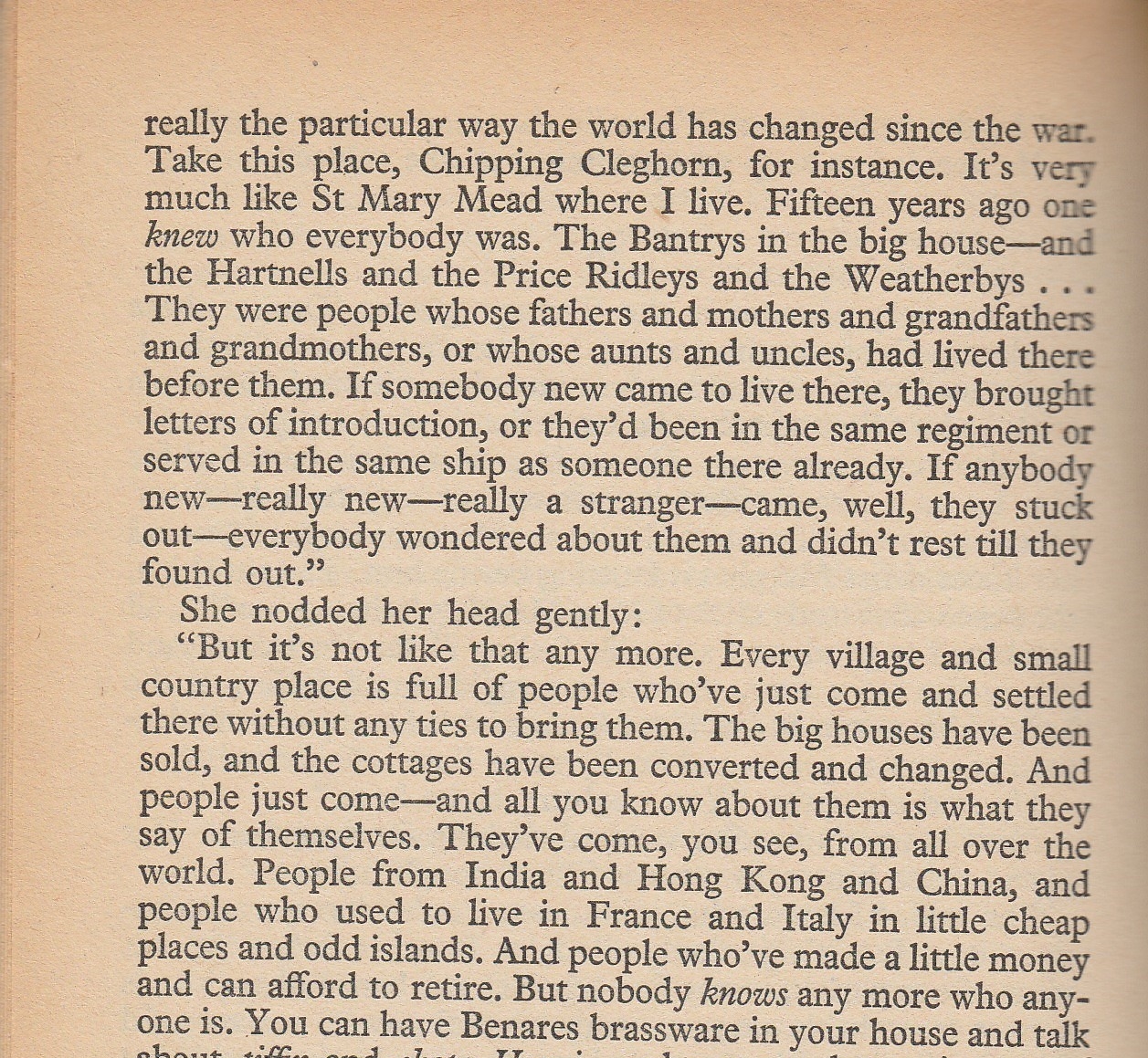
During and following the War, most households had had to learn to manage without servants and butchers without boys. Straitened means meant that previously well-to-do people had had to sell up and leave, or downsize households that their families had lived in for generations, as Miss Marple explains:
If King’s Abbott’s Caroline Sheppard had wanted to know what was happening in Chipping Cleghorn, she would have had to get a copy of the North Benham News and the Chipping Cleghorn Gazette – the old grapevine had gone.
Such a village, where no-one really knows who other people are, provides a setting that allows Agatha Christie to explore in more detail one of her common themes : How do you really know who someone else is?
Refugees
The household at Little Paddocks, the scene of the crime, consists almost entirely of refugees of one sort or another who have settled there since the end of the War. Mitzi, the cook, is an actual refugee from the post-war horrors of Central Europe, whereas the others – Mrs Haymes, Dora Bunner, Patrick and Julia Simmons – could be classed as economic refugees scrounging off the householder, Miss Blacklock. Two of them are twins (‘Pip and Emma’) who do not even recognise each other.
Miss Blacklock herself is also in hiding: Dora Bunner is the only person who knows who she really is, but is happy to collude with her in concealing her identity.
Among the neighbours who drop in on the day for which the murder had been announced, four, the Swettenhams and the Easterbrooks, are themselves refugees of a kind – from a shrinking British Empire.
The one person that Miss Marple can be sure is who they say they are, is the vicar’s wife Bunch, but then Bunch is her god-daughter.
Open Doors and Shortages
Although no-one can be quite sure who anyone else is in Chipping Cleghorn, everyone is happy to leave their doors wide open when they go out. This might seem strange at first, and the police cannot understand it.
The houses, however, were left open not as a sign of mutual trust – no-one had anything worth taking anyway. Open doors enabled the village’s own version of the post-war black market to function, and it is the one thing that everyone in the village does know about.
Everyone was forced to collude with each other as they coped with the shortage of every essential, from food to fuel to clothing.
Strictly speaking, such a black market means that just about every person in the village is breaking the law, something it is difficult to imagine the redoubtable Mrs Price-Ridley, Miss Wetherby and Miss Hartnell doing in days gone by.
As Inspector Craddock realises, it is the Chipping Cleghorn ‘open door policy’ that allows the murderer to get hold of the weapon, and to smuggle Rudi Scherz into Little Paddocks to perform his comedy before he is shot with it.
One thing Craddock fails to grasp is the implication of the central heating being left on at Little Paddocks when it wasn’t really necessary. It is mentioned by every visitor because, at a time of coupons for every necessity, they clearly each found it worthy of comment that vital fuel was being squandered in such a way.
That proves to be the key to unlocking the mystery.
Agatha Christie and Identity
This book was Agatha Christie’s 50th, and only one of many that has characters concealing their identity or stealing someone else’s, but that is a theme that runs right through this story.
The question is asked of every character: ‘How do we really know who this is?’ Agatha Christie’s interest in such a question, and its answer, goes back to her early childhood.
The Gunman
From the age of about 6, Agatha Christie had a recurring nightmare featuring someone she called The Gunman:
“The gun was part of his appearance … that of a Frenchman in grey-blue uniform, powdered hair in a queue and a kind of three-cornered hat, and the gun was some old-fashioned kind of musket.” 1
In her dreams, this Gunman would appear at a normal tea-party at home, happily joining in the conversation; only Agatha knew who he really was. Sometimes she would look into the face of her sister or mother at the party and realise that it was actually the Gunman looking back at her.
The childhood Gunman nightmare left its traces in the adult. In 1926, Agatha Christie was alone and vulnerable after her mother’s death. She was also on the verge of a breakdown as she cleared her mother’s effects from Ashfield, her childhood home. One day, her then-husband Archie visited from London.
She describes recalling
… that old nightmare of mine – the horror of sitting at a tea table looking across at my best-loved friend, and suddenly realising that the person sitting there was a stranger.
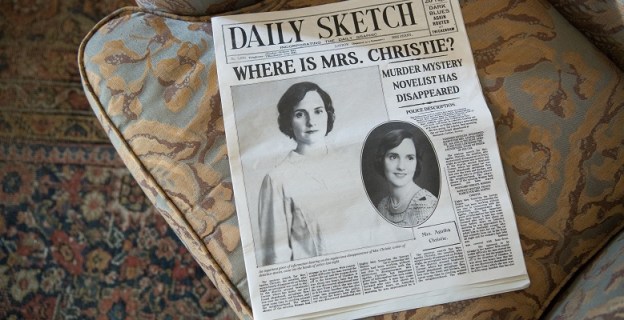
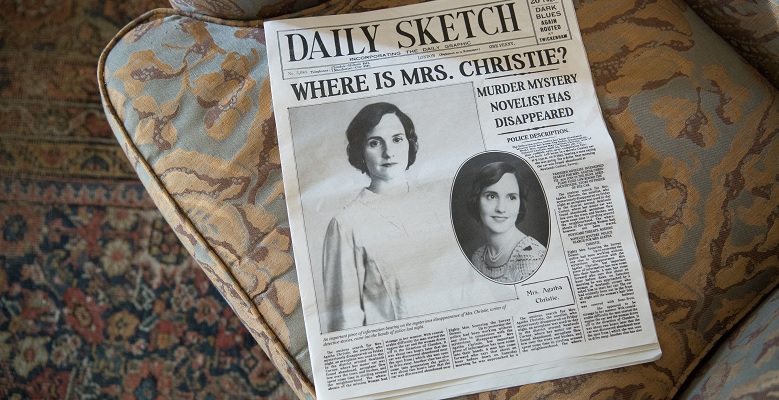
In fact, Archie had come to tell her that he loved someone else, and this tips her over the edge. Agatha went into hiding, running away to a place where no-one would know her. There, for eleven days, she herself adopted a false identity, using the surname of Archie’s lover.
Her second husband, Max Mallowan, served in North Africa during WWII, and she had similar fears that she would not know him when he returned after a long period on duty. Thankfully, she did, and the Gunman was perhaps finally put away for good, but the possibility that people were not who they seemed to be continued to inform her plotting.
Old School – Hinchcliffe and Murgatroyd
Apart from the vicar and his wife, the only people in Chipping Cleghorn about whom there are no doubts as to their identity are Miss Hinchcliffe and Miss Murgatroyd. These are two late middle-aged ladies who have long been living together in a loving relationship.
Hinchcliffe is the strong character, with ‘a short man-like crop and weather-beaten countenance’. She is fiercely protective of the ‘fat and amiable’ Murgatroyd. These two characters had been gestating in Agatha Christie’s mind for half a century.
Murgatroyd (Joan Sims) and Hinchcliffe (Paola Dionisetti) in the BBC production of A Murder is Announced
She had not been to school as a young girl and had few friends of her own age, so she invented her own pretend-school for girls, known simple as The School. She populated it initially with young girls around her own age (6-11), and kept developing them in her imagination well into adulthood. Each had a specific character, and the first she invented were Ethel and Annie.
Ethel was … clever, good at games, had a deep voice and must have been rather masculine in appearance. Annie … was shy and nervous and easily reduced to tears… She clung to Ethel, who protected her on every occasion …
“Ethel never married but lived in a small cottage with the gentle Annie – very appropriate, I think now: it’s exactly what they would have done in real life.1
Hinchcliffe and Murgatroyd are, unlike most of the other characters at Little Paddocks on the night of the murder, amusingly and sympathetically portrayed. Also, unlike everyone else, no-one seriously questions who they are.
That is because Agatha Christie knew exactly who they were – she had been carrying them around in her head since the age of 10, and she treats them with great care. Most of the characters populating her books were based on people she spotted on buses or in cafes, about later whom she could not care less. It is therefore rare in her books that genuine grief at the passing of another is depicted, but it is in this one:
Nobody offered Miss Hinchcliffe sympathy or mentioned Miss Murgatroyd’s death. The ravaged face of the tall vigorous woman told its own tale, and would have made any expression of sympathy an impertinence.
The presence of these two genuine Agatha Christie characters, whom she loved and knew so well, helps lift this story up to a different level from most of the others.
Aftermath
After the murderer has been apprehended, two of the ex-suspects get engaged to be married, but even so there is little likelihood that everything in Chipping Cleghorn will be settling back to normal, as is usually the case with a swigatha.
For one thing, in the wake of the Second World War there was no ‘normal’ to settle back into, and in any case Hinchcliffe for one would forever be haunted by the ghost of her friend.
Notes
1 All these quotes are taken directly from Agatha Christie, An Autobiography. She also relates how her sister Madge would play a game, pretending to be another, older sister who was mad and lived in a cave:
‘You know who I am, don’t you dear? I’m your sister Madge. You don’t think I’m anyone else, do you? You wouldn’t think that …’ I used to feel indescribable terror. Of course I really knew it was only Madge pretending – but was it? Wasn’t it perhaps true? That voice – those crafty sideways glancing eyes. It was the elder sister.
During the days of 18-20 June, 2017 a conference was held at Lucy Cavendish College, Cambridge : ‘Agatha Christie – a re-appraisal’. There were two days of presentations and keynote speakers, with a getting-to-know-you session on the first evening and a reading of her play A Daughter is a Daughter on the second. This was the fourth such conference, and the first in Cambridge.
It was perfectly brilliant of the organisers to use this particular college, because Cavendish is the family name of the main protagonists in The Mysterious Affair at Styles, a book referenced many times during the course of the two days. Indeed, the main College building used was almost Styles-esque.
The Strathaird Building, Lucy Cavendish College
Destination Unknown I had no idea what to expect. I had heard about the event from Sophie Hannah, who was attending and had helped to organise bits of it, and I guessed it would be full of fans like me.
What I certainly didn’t expect was that I would be one of the oldest people there, nor that most of the people attending had travelled much further than I had to get to it: five from the US, one from Brasil, one from Melbourne…
There was a real mix of nationalities and ages.
Dumb Witness The papers presented ranged from the strictly academic to almost fanzine level, and the content of the presentations ranged from the quite brilliant to the positively barking: I cannot say that I bought into all of the pet theories on show.
I soon realised that every one of the other 45 or so people there knew far more about Swigatha’s life, books and characters than I did. Some are only half my age, or less. I had begun to consider myself a bit of an expert but, boy, am I not.
One of the presentations was entitled Unnatural Death: Agatha Christie’s Lesbians, and it was superb, providing real, and certainly not fanciful, insight into AC’s depiction of some of her characters.
Another was Old Ladies on Trains: The Inherently Chronotopic Nature of Miss Marple’s Detection in 4:50 from Paddington. I wasn’t so sure about that, possibly because I couldn’t hear half of it and didn’t know what chronotopic meant. When I got home, I looked it up, but there was no entry for it in my Chambers.
The Secret of Chronotopes I contacted a niece-in-the-know, who has done a creative writing course: it loosely refers to the inter-relationship of space and time and is a consideration in any literary composition. She said.
Eventually the penny dropped, and I saw that, in 4:50 from Paddington, Swigatha uses time-space in a unique and inspired way. It starts with Miss Marple’s friend travelling to see her by train (the 4.50 from Paddington). For a short while, another train is running in parallel to it:
At the time when the two trains gave the illusion of being stationary, a blind in one of the carriages flew up with a snap. Mrs McGillycuddy looked into the lighted first-class carriage that was only a few feet away. Then she drew in her breath with a gasp and half-rose to her feet. Standing with his back to the window and to her was a man. His hands were around the throat of a woman who faced him, and he was slowly, remorselessly strangling her.
Almost immediately, the other train then draws away. No-one at the station believes Mrs McGillycuddy’s story, so she carries on to Miss Marple’s house and tells her what she has seen. They report it to the police, who find nothing.
Miss Marple is the only person who believes her friend. She sets out to deduce where the body MUST be, given the constraints of time and space that the murderer had to deal with when disposing of the body. It had to be done i) before the train reached its destination and ii) at a place where the body could not easily be found.
Hers turns out to be a quite brilliant deduction, and, yes, ‘inherently chronotopic’ (but there is an element of “now I know that, what do I do?”).
Come Tell Me How You Live
There was a variety of presentations about different aspects of Agatha Christie and her work.
The Man from Melbourne presented a paper on AC’s treatment of Americans. Tito Prates, the Brazilian Ambassador for Agatha Christie, discussed the challenges of writing a modern biography of her.
There were papers on Agatha Christie and Evil, her subversion of legal ‘justice’, Agatha Christie as Gothic Author and so on. About half the people there were presenting papers.
Tito in conversation whilst a presentation on the Mousetrap archive is prepared
The Big Four Two of the most enjoyable presentations were from pairings of young Americans.
Kemper Donovan and Catherine Brobeck are literature graduates from Stanford and Yale who host a weekly podcast called All About Agatha, which analyses each Christie novel in order of publication (by June 2017 they had got as far as 1932).
Their unscripted talk looked at how Swigatha treats the aftermath of the revelation ‘whodunit’: in almost all of her stories, she concentrates on reconciliation between the surviving characters, rather than on any residual bitterness or lasting desire for revenge. Maybe that is one reason why they are so enduringly popular.
The two presented very well together and their podcast has as a result become a must.
The second pair, Audrey Cooper and Emily Lilley, are the brains behind The Year of Agatha. They devoted that year (2016) to reading Swigatha’s complete works, sharing their thoughts and findings through twitter, facebook, Instagram and Google Blogger.
They had some great ideas to draw people in, and here are two:
they compiled a quiz app for new readers which could recommend the best swigatha for them to start (or continue) with, based on the answers
they ran a knockout competition, pitting pairs of swigathas against each other and asking the online community to vote for their favourite
The knockout continued until only two books were left. I’ll leave it to you to guess which were the last two books standing, and who won the final, but here is a heavy hint: and then there was one…
This presentation was simply delightful and gave much food for thought. Most of the people wanting to know more about Agatha Christie were younger then the brains behind The Year of Agatha.
Emily Lilley sporting The Year of Agatha’s T-shirt: she has promised to add Parker Pyne, Battle etc to the next one
A Daughter is a Daughter The cast for the read-through included members of the disbanded Agatha Christie Theatre Company, two of the organisers and Sophie Hannah herself. The Company’s most recent director, Roy Marsden, was there too (he played PD James’ Inspector Dalgliesh in the TV adaptations of her books).
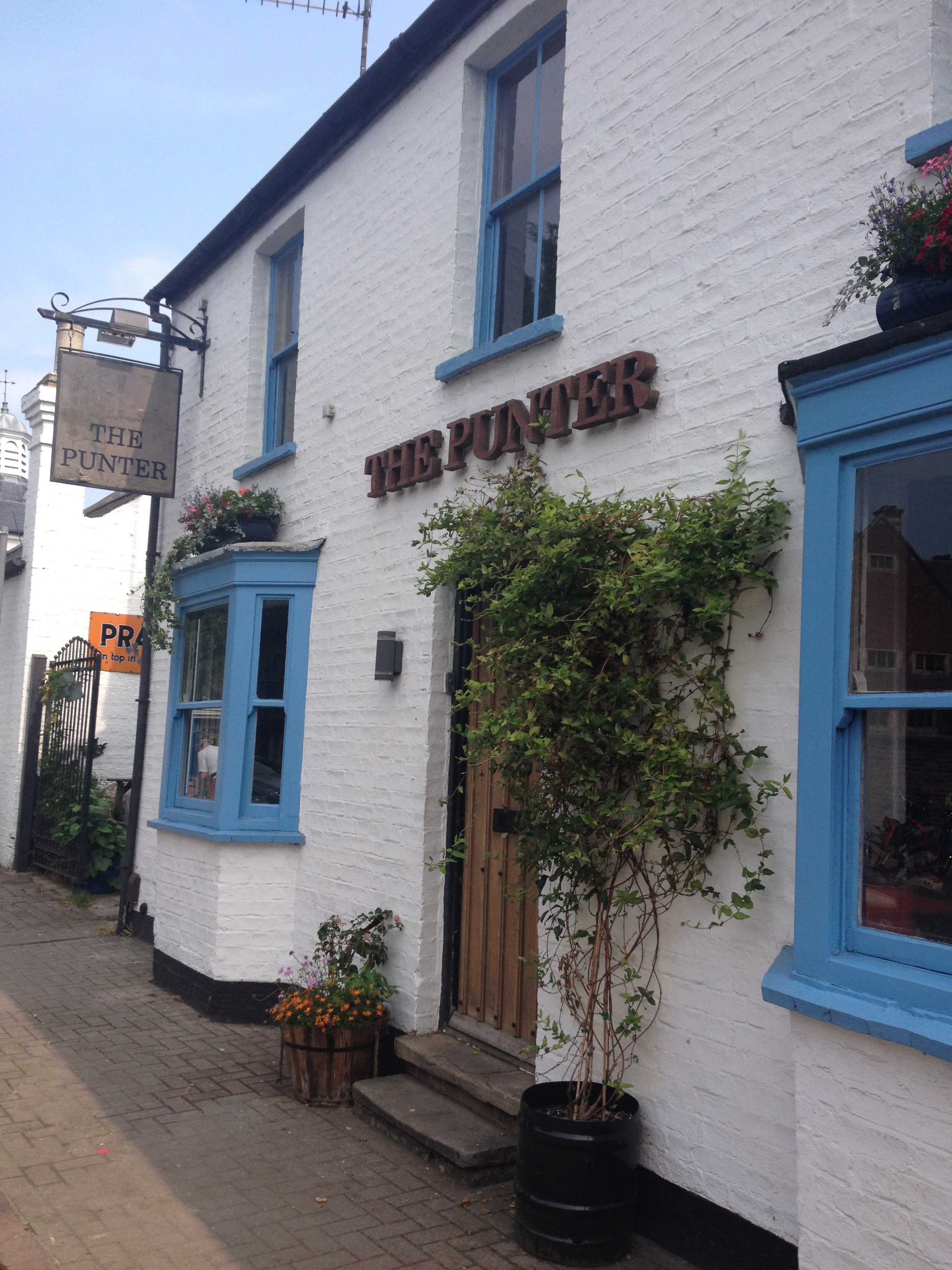
It was a unique event, exposing the Mary Westmacott in Agatha Christie. We repaired to the Punter afterwards to be regaled with a huge firework display at a nearby cricket ground (the University students were celebrating the end of exams.).
The Conference Pub
Verdict
I could only stay for a bit on the final day, but I am so glad I went. It was a terrific event, conducted in sweltering conditions that somehow were not oppressive.
It was also reassuring and fun to meet so many other people who have come to the same conclusion as I have: that there is much more to Agatha Christie than is generally acknowledged. Agatha Christie: A Re-appraisal is basically what the Swigatha blog and website is all about.
Go next year? I just might!
REFERENCES
Here are a couple of links to the projects mentioned:
Burgh Island Books : a parlour game based on BBC Radio’s Desert Island Discs programme, only this time our castaway is sent in isolation to Burgh Island off the coast of Devon, the setting for And Then There Were None Five Little Pigs – the finest Poirot adaptation yet : an in-depth look at the beautifully-made ITV production Poirot’s Use of French in Death on the Nile: in most of the stories featuring Hercule Poirot, his French usage is limited to exclamations or curses, but in Death on the Nile some of his comments give away some of his thought processes as he investigates Linnet’s murder Who’s Who in Chipping Cleghorn: look at the way that Agatha Christie’s portrayal of village life had changed by the 1950s based on the village featured in A Murder is Announced Old Sins Have Long Shadows: Childhood and A Pocket Full of Rye: a look at the childhood of the characters involved in the events at Yewtree Lodge







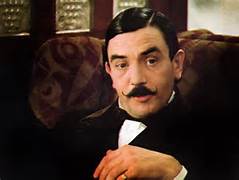

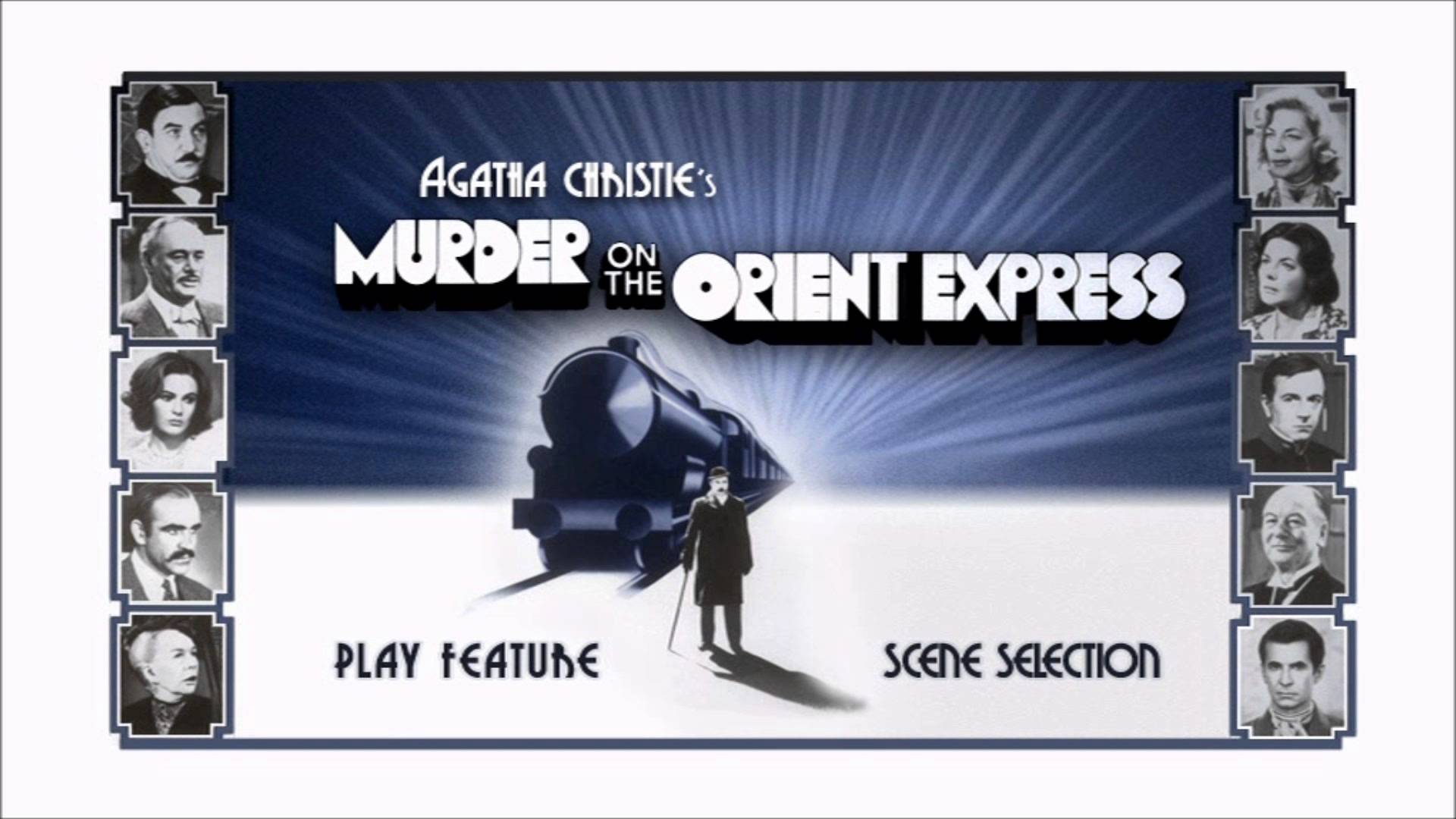 Albert Finney is a believable Poirot, even if a very young one (he was 38). He plays it for laughs quite a bit – in fact, most of the cast do. Jokes are added. Vanessa Redgrave, in the role of Mary Debenham, spends the whole film in a wry state of amusement at what is happening around her.
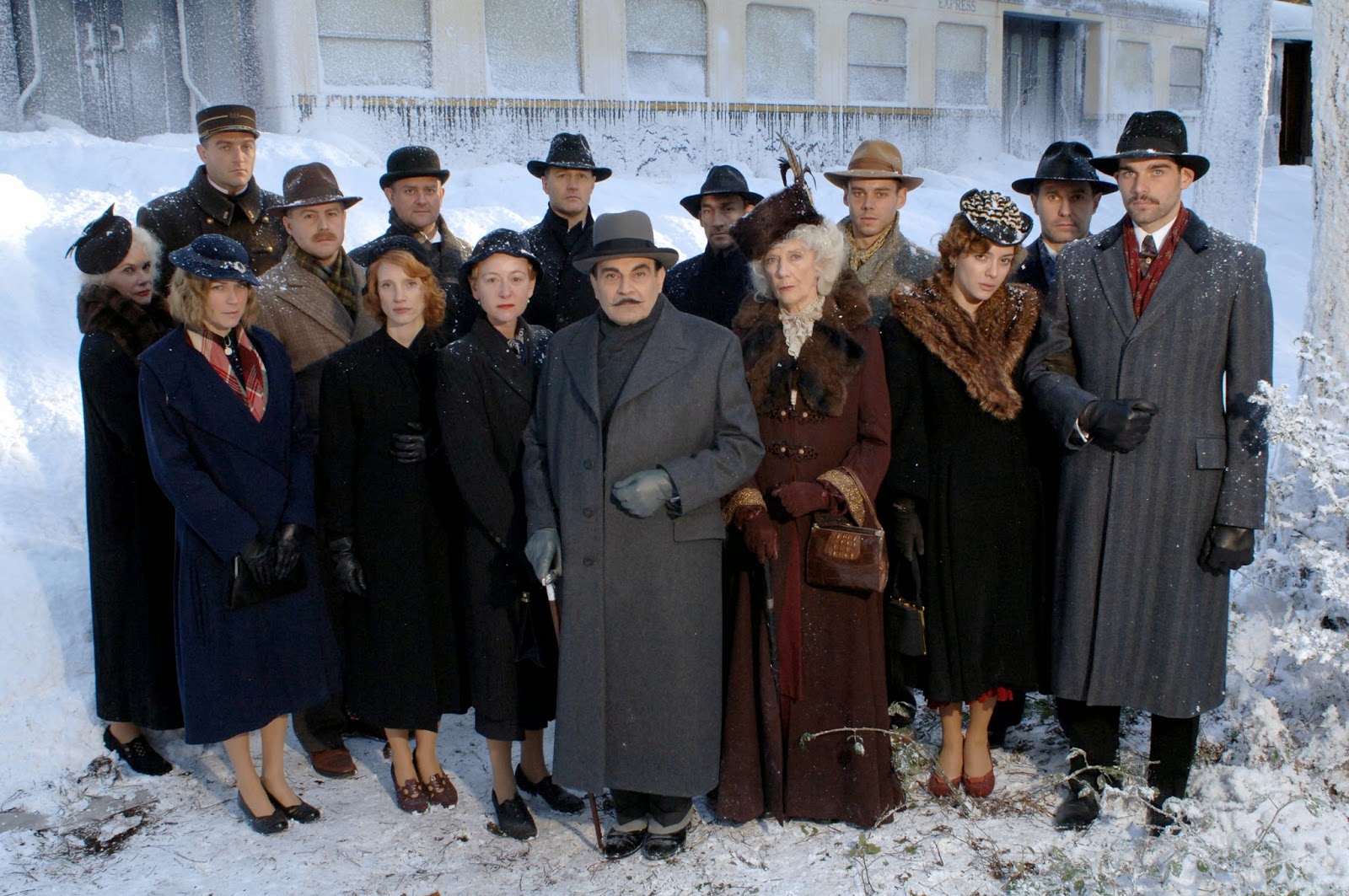 Overall, this is a much darker version of the story (literally). As the train is held up in the snowdrift, its facilities and comforts become unavailable to the passengers. There is no running water and they are forced to sit in semi-darkness to await their fate. This is all a splendid contrast to the fun and frolics of the film, and there is no hint of self-congratulation at the end.




 Swigatha