Author Archives: swigatha

Poirot’s Use of French in ‘Death on the Nile’

Introduction
Every reader’s experience of a book is affected by various elements, including its presentation (cover illustration, the paper, the font used), its provenance (where it came from) and the age and circumstance of the reader when they first read it. Even so, the primary stuff of a book is the language used in it, the style and the words. Books featuring the Belgian detective Hercule Poirot are written in two languages, English with a smattering of French; given that most of her readers are children or adults who don’t speak French, I thought it was time to examine how it is used and whether it adds to the experience of the books. In doing so I uncovered one novel in which the French used is crucial to the understanding of what is happening.

Poirot-french examples
In most of the Poirot stories, Agatha Christie uses a variety of simple French exclamations and expressions to establish the detective as a person who thinks in a different language to everyone else. A dictionary of “Poirot-french” would be limited in the main to a few hundred phrases, pleasantries and, especially,  exclamations. The latter are such as might have been used by ‘un bon catholique’ such as Poirot at the end of the 19th Century (around the time when a very young Agatha Christie learned to speak French). Here are three very typical examples of ‘Poirot-french’:

Parbleu!
Nom d’un nom d’un nom!
Sapristi!

Interjections such as these are repeated throughout the 33 novels and 50-plus short stories that feature Hercule Poirot, writen between 1916-1969. They are toned-down versions of exhortations to le bon Dieu. English equivalents might be ‘Good Lord’, ‘Great Scott!’ and so on (in the Granada TV adaptations of these stories, these exclamations, in their English translations, are also routinely made by Captain Hastings, who never uses them in the books.)

Simple stuff
As readers work through the Poirot oeuvre, those with even the most limited understanding of French to start with will begin to recognise his French expressions as old friends. They may have to decide for themselves what they actually mean (and not just Anglophone readers – these books have been published in over 100 different languages).

Phrases in French are presented in italics to make them stand out (and easy to skip past). Most people would probably consider them to be simple embellishment, indications that Poirot is amazed / annoyed / pleased, as the case may be, rather than crucial to the stories.

In one book, however, there is a bit more to it than that: a reader skipping past the italics will miss a few elements that make it one of the better Christie novels.

Not so simple stuff 
That story is ‘Death on the Nile’.  Written in 1937, the Poirot-french used by Agatha Christie in it is a bit more varied than usual, especially when Poirot is muttering to himself. She includes an obscure proverb, an old Belgian poem and other utterances that give us a nudge as to Poirot’s thought-processes, and even pointers as to what is actually going on, that are not given elsewhere in the English text.

Rather than ‘skipping past the italics’, a reader hoping to solve this puzzle would be advised to try and work out what Poirot is saying. When I read the book for the first time, at the age of 11, I delighted in these French bits and memorised most of them, even if own translations were somewhat wide of the mark. It all seemed to add to the fun.

Death on the Nile
The story’s setting is a river cruise up the Nile, and, just as in the other transport-driven Poirot books from the 1930s (Murder on the Orient Express and Death in the Clouds), the SS Karnak has a wide range of nationalities on board: as well as the Egyptian crew, there are French, German, American, Italian, English and (of course!) Belgian passengers. With one notable exception, none of them are thrown when Poirot switches from one language to another, and that is a hint in itself.

The plot of Death on the Nile is a classic Christie love-triangle-with-a-twist: Simon Doyle dumps his fiancée Jacqueline de Bellefort and marries her (rich) best friend, Linnet; Jackie stalks and threatens them on their honeymoon; Linnet is killed and Simon and Jackie are reconciled. Apparently… Further murders ensue amongst a complicated tangle of side-plots, including stolen jewels, trustee fraud and even an on-board terrorist.

Follow the French and you will be following the single strand that untangles the mystery.

The Use of French
Agatha Christie’s use of French is subtle. I have chosen 7 examples from the text (there is a full lexicon of all the French used in this book at the bottom of this blog).

1 Empressement

Here is an example from  Chapter 1, when Poirot appears for the first time and is shown to his table at Chez Ma Tante (all the illustrations are taken from the 1977 Fontana edition). Although Poirot doesn’t say the word, he is clearly thinking it.

french-1

Empressement is not an easy word to guess. When I first came across it, aged 11, I thought of the nearest word to it in English, so my translation of empressement was ‘being impressed by someone’.   It actually means ‘alacrity, eagerness’, but, although they are not the same thing, the meaning of the sentence is not radically changed by inserting my version: Blondin clearly is impressed by Poirot and will always find a table for him.

Agatha Christie could have used “alacrity” but chose not to. Empressement is not a word that is in common use in English. By using this one word she creates an effect whereby the reader is watching the events of the whole of this pivotal scene through Poirot’s eyes, rather than observing him in action, as we do for the rest of the book.

2 Une qui aime…

We are still in the restaurant with Poirot as he sees Simon and Jackie for the first time, dancing, and hears them discussing their honeymoon in Egypt. He makes a crucial observation:

french-2

Whenever one is allowed access to Poirot’s inner thoughts, and it does not happen often, then one had better pay attention; his first impression of character is never shown later to be misplaced in any of the books in which he features.

The meaning of the phrase in italics here is not that difficult to work out, presuming you can guess what the verb aimer means and that une is the feminine form of ‘one’ and un the masculine. Nor do  you need to know the reflexive verb se laisser;  Poirot’s echoing of Jackie’s “I wonder…” tells you what it must more or less mean.

If you skip the italics, however, you will be missing a hint about the driving element of the relationship between Simon and Jackie, the two main protagonists: one who loves, and one who is content to be loved.

Tiens! C’est drôle

In Chapter 6, Poirot repeats the same phrase when he first actually meets Simon, on holiday in Egypt. By the time of that meeting, Simon has married Linnet instead, and they are on their honeymoon. They are being stalked by Jackie, and Simon has just declared that he would like to “wring the little devil’s neck”:

french-3

Now, Poirot had just spoken with Jackie, and she had used word-for-word the same simile as Simon does about the moon and the sun. So Poirot’s reaction when he hears these words again minutes later – loosely translated: “Hullo, that’s a bit funny!” – should make an alert reader sit up and store this hint away for later: Simon was supposed to be avoiding Jackie. The use of the word drôle, which has an almost exact English equivalent, makes the phrase quite easy to decipher. Even so, Simon does not understand it and Poirot avoids translating it for him.

It is Simon’s stupidity and simplicity that is also hinted at here: for a start, he is seemingly the only character in the book who hasn’t a clue what Poirot is saying when he lapses into French! Jackie had already told Poirot that Simon was “a very simple person”.

Later on, recalling these conversations, Poirot realises that Jackie had from the start been training Simon in exactly what to say and do, to avoid his giving the game away with his gormless comments. Unfortunately for her, she failed.

Nom d’un nom d’un nom!

Another hint at the presence of stupidity-in-action is given in Chapter 13, when Poirot and the doctor examine the crime scene.

french-4

Nom d’un nom d’un nom!” is one of Poirot’s strongest exclamations, and he uses it on many occasions, usually when confronted by something that stretches his credulity to its limit (as here).

The usual French phrase would have been ‘nom d’un nom’: ‘in the name of God’, a euphemism for nom de Dieu. With three noms*, you could translate it as ‘What in the name of God and heaven is this nonsense-!’

*In the Granada TV version of Death on the Nile, David Suchet, clearly enjoying himself, is heard to stretch it to four…

C’est de l’enfantillage

French 5

This extract is taken from the same scene.

The stem enfant of the word enfantillage should make the meaning of Poirot’s comment pretty obvious: ‘This is sheer childishness’.

His suggestion of childishness, rather than ‘melodrama’, is a huge hint as to the identity of the perpetrator. There are many melodramatic characters on board the Karnak – Mrs Otterbourne, Richetti, Jackie herself – but the only one simple, or childish, enough to believe that it might be possible, for someone who has been shot point blank in the head, to dip her finger into the wound and write the accusatory letter J on the wall, is Simon.

On ne prends pas les mouches avec le vinaigre

In chapter 22, Poirot and Race make a further search of the same cabin.

french6

Poirot is examining two bottles of nail varnish, one full and one empty. His reaction after sniffing them made little sense to me when first I read it: “You don’t put vinegar on your moustaches” was my ill-informed guess.  The actual translation is “You don’t catch flies with vinegar”, but even that does not tell us much.

What I think he is saying is that Linnet presumably used make-up to make herself look attractive to herself and others but she would hardly have been applying something that had should have such a bitter smell.

He has no intention of explaining himself to Race. The rest of his reply seems to indicate that there are no clues to be found. Poirot usually scorns the idea of crawling around looking for clues such as cigar ash, the absence of which here he appears to lament. His use of the French proverb indicates that he has found something far more significant – that there is a residue of something red and acrid-smelling in the bottle that was not there originally – and also that he wishes to keep it to himself.

La vie est vaine

In Chapter 24, Poirot is once again alone with Jackie.

French7

They meet just after the discovery of Louise Bourget’s body. Poirot quotes to her the whole of a poem by the Belgian writer Leon de Montenaeken (d 1905). When I first read it I thought Poirot had made it up!

The French is very simple but not easy to render into English. Here is my attempt (the notes at the end use a more literal one):

Life is a play
We love and we hate …
And then it’s good-day

Life is so slight
We hope and we dream …
And then it’s good-night

It is not immediately obvious what the relevance of the poem is here. It is like a funeral oration, so it could be in reference to Linnet, who has lived and loved, but has died suddenly while still young. The context in which it is placed, however, prompts a different reading.

In the lead-up to the poem, Poirot once again recalls Jackie’s sun and moon simile, the thing that had first aroused his suspicion of her. He looks at Jackie “half-mockingly”, because by now he does not believe a word of what she says, and “half with some other sentiment” because he is genuinely sad about her likely fate.

Later, on the same page, Poirot tells Race that he knew for sure what had been happening when they found Louise Bourget. The words of the poem, recited just afterwards, could equally apply just as well to Jackie as Linnet, because Poirot by now suspects that she will also die young (by capital punishment). As it turns out, his sympathy for her allows her to take her own way out.

Mesdames et Messieurs

The French used by Poirot in Death on the Nile contains hints about the workings of his mind during the investigation which he does not express in English or make clear to the others until it has finished. For the rest of the book, he openly discusses (in English) all the other twists such as the stolen pearls, the Italian terrorist and the crooked trustee, but the reader who ‘skips past the italics’ might miss out on these hints:

  • That Jackie is totally besotted by Simon and will do anything for him; he’s quite happy to be taken in hand (une qui aime et un qui se laisse aimer)
  • That Jackie had trained Simon in what to say and do even though he was supposedly not speaking to her (tiens! c’est drôle, ça)
  • That a child-like simpleton murdered Linnet in her cabin (c’est de l’enfantillage) – Jackie had already told him that Simon was “simple”…
  • That the strange red substance in the nail varnish bottle (‘on ne prends pas les mouches avec le vinaigre’) is an important (if obscure) clue as to how the murder was contrived

Poirot’s use of French can be divided into three groups – exclamations, pleasantries and obscure commentary. It does not take a genius to understand most of the phrases that comprise the first two groups, but in Death on the Nile readers need to also attend to his murmurings if they are going to have a decent chance of working out whodunit.

Death on the Nile Dictionary

Here is a list of all the expressions in French used by Hercule Poirot in Death on the Nile.

À merveille!: ‘Excellent’;  usually used by Poirot as an adverb (i.e. ‘we proceed à merveille’)
À votre santé: ‘Your good health’ (Poirot toasts the Otterbournes, one of whom is a dipsomaniac)
Ah, non!: ‘No way!’ Reaction to Bessner after the discovery of Linnet’s body
Ah, vraiment! ‘Indeed!’ Poirot is suspicious of Pennington’s motives
article de luxe: ‘Luxury article’ – in reference to Jackie’s pistol

Bien: ‘Ok, good, fine’ (variously)
bon Dieu!: ‘Good God’
Bonne nuit: ‘Goodnight’

Cache: ‘Hiding-place’ (for Mrs Otterbourne’s booze)
Ce cher Woolworth: ‘Dear old Woolworths’ – Poirot considers a cheap handkerchief
C’est de l’enfantillage!: ‘This is sheer childishness!’ Still musing on the letter J scrawled in blood on the cabin wall.
C’est vrai: ‘That is true’. To Race
Cette pauvre petite Rosalie: ‘That poor young girl.’ He also refers to ‘cette pauvre Madame Doyle’ but it is Rosalie Otterbourne that he feels sorry for.

Écoutez, madame: ‘Now listen, madame…’ The beginning of a long speech to Linnet.
Eh bien… : ‘Well….’
empressement: ‘Eagerness, alacrity.’  Poirot observes the maître d’ finding him the best table
en verité: ‘In truth’

femme de chambre: ‘chamber-maid’

jeune fille: ‘young girl’

la politesse: ‘politeness, courtesy’
le roi est mort – vive le roi!: ‘The king is dead, long live the king’: referring to Linnet. Joanne Southwood had previously (and more accurately) referred to her as “la Reine Linette”.
les chiffons d’aujourd’hui: ‘today’s chiffons’: the expression ‘causer chiffons’ used to mean to gossip about clothes; Rosalie and Jackie have been comparing lipsticks, which Poirot sees as its modern equivalent.

Ma foi!:  ‘Indeed!’ This is followed by “madame, that was close” when the boulder narrowly misses Linnet. The nearest literal translation to this would be the old-fashioned “i’ faith”
Mais oui, Madame: ‘Indeed it is, madame’ (to Mrs Allerton, when she proclaims the lovely night)
Mais c’est tout: ‘But that’s all’
Moi, qui vous parle: ‘I, I am telling you’ – Poirot being emphatic to Race.
mon ami: ‘my friend’ (to Race). An endearment often addressed to Hastings in other books
Mon cher Colonel: ‘My dear Colonel’ (Race again)
Mon Dieu!: ‘My God!’ When Simon complains that Jackie isn’t being reasonable
Mon enfant: ‘my child’ – addressed to Jackie (not Simon!) when he tries to give her advice

Nom d’un nom d’un nom!: ‘In the name of God and all the saints in heaven!’ Poirot sensibility is outraged by the J scrawled in blood on the cabin wall.

On ne prends pas les mouches avec le vinaigre:  ‘You don’t catch flies with vinegar’. Poirot finds something suspicious in the nail-varnish bottle. An English version of this is “you catch more flies with honey than vinegar”.

Parbleu!: ‘Heavens above’ – followed by “but I am not the diving seal!” To Mrs Allerton
Précisément: ‘Precisely, exactly’. Used by Poirot a great deal in all his stories
Peut-être: ‘Perhaps’. To Colonel Race

Quel pays sauvage: ‘What a wild country…’ to Race
Qu’est-ce qu’il y a?: ‘What is it?’ In response to an exclamation from Race.

Sacré: ‘Damn!’ Unusually strong language for Poirot. The French translator Marie-Josée Lacube changes it to “Enfin!” in her version of “Poirot Investigates”.

Tenez!: ‘Now look here!’ (to Rosalie Otterbourne, who has been fiercely criticising Linnet)
Tiens, c’est drôle, ça: ‘Hello, that’s a bit funny’… when Simon unwittingly lets a clue slip
Très bien, Madame: ‘Very well’ (to Mrs van Schuyler)

Une qui aime et un qui se laisse aimer: ‘One who loves and one who lets himself be loved’

Zut!: ‘Blast!’ Poirot fails to find the necklace

La vie est vaine

La vie est vaine                 La vie est brêve
Un peu d’amour               Un peu d’espoir
Un peu d’haine                 Un peu de rêve
Et puis bonjour                 Et puis bonsoir

Life is vain                        Life is short
A bit of love                      A bit of hope
A bit of hate                     A bit of dream
And then good-day         And then good-night

Swigwatch 1

As age slowed her down, Swigatha produced only one book a year – a “Christie for Christmas”. It looks like BBC1 is going to do likewise: after last year’s triumph with ‘And Then There Were None’, they are showing a new version of ‘The Witness for the Prosecution’, starting on Boxing Day at 9pm. This was originally a short story in The Hound of Death collection, so I suspect they must have added quite a bit to it to spread it over two nights.
sdfgdgsdg

Browsing the Radio Times christmas edition, I came across two days of Agatha Christie tribute on the Drama Channel, with a strange mish-mash of programmes, none of which include Poirot. I doubt if anyone could watch this particular channel for two solid days, so here are some highlights lowlights and ok-lights for swigatha fans.


17th December

8am The Agatha Christie Hour

In a Glass Darkly
The Girl in the Train
The Fourth Man

This programme made, in the 1980s, featured short stories from the early 1930s collections Parker Pyne Investigates, The Listerdale Mystery and The Hound of Death.  They are not all great stories and not great programmes – one to watch while stirring the pudding.

11am The Murder at the Vicarage
colonel-protheroe
A faithful version with the excellent Joan Hickson and (equally good) Paul Eddington and Cheryl Campbell as the inhabitants of the Vicarage.
The victim in a particularly dislikeable man, brilliantly played by Robert Lang. Whoever gave him the word “sewer!” to describe someone he found distasteful did him a great favour, and  he revels in it.
sdgdfgdfgdfg
1pm Sleeping Murder 
Another good version, and another of the Hickson Marples, which were so much better made than the McEwen, Rutherford and McKenzie Marples. For this story , not the most entertaining one, the production team certainly picked some memorable faces for the minor parts…but the star performer was Frederick Treves, as the dead girl’s creepy brother.
   
Repeated on Sunday 18th December.
dfgdfg
3pm Agatha Christie A Life in Pictures
Episode 1 – but there is no schedule for any other episodes. Apparently “a Drama based on her life”. Worth a look?
dfgdfgdfgd
5pm Ten Little Indians
1960s Hollywood film with Oliver Reed, Herbert Lom, Charles Aznavour, Richard Attenborough – you can see where that one is heading! Avoid. Also avoid the repeat on Sunday 18th December.
fghfghfgh
7pm Murder Most Foul
Not a swigatha but included because Margaret Rutherford plays the part of “Jane Marple” investigating a crime loosely based on a Hercule Poirot mystery.  Unbearably awful rubbish, on again the following day.

18th December

3pm At Bertram’s Hotel
One of my favourite Marple books. It is given a fair airing but doesn’t quite work, even with The Two Joans (Hickson and Greenwood) in tandem as Jane Marple and Selina Hazy
 .
7pm Nemesis
Anyone who has not seen this is in for a treat. In my opinion this is the best adaptation of an Agatha Christie story that I have seen. It is that rare beast – something that manages to improve on the original story. It does so by introducing two characters who don’t actually appear in the novel (although one is mentioned often enough!). With Joan Hickson in mesmerising form, and a brilliant supporting cast – one that includes these two, the actors playing the characters that aren’t in the book. Polar opposites, they have become firm friends by the end of the film….
 One Image Only
   
OTHER NEWS
On Christmas Eve, the Alibi channel, which I cannot receive as it is not on Freeview,  is showing The Hickson Marples (think I’ll keep that expression!) from 7am until 3am on Christmas morning. Buy the box-set and avoid 8 hours of adverts.

The Merger of Roger Ackroyd

As part of the Swigatha project, there will be a website that considers each of Agatha Christie’s detective stories (www.swigatha.com). Each page will consider not just the story, but also other elements that might add to that story – for example, the background to its writing, the impact of the book on the reader, the reactions both when it was first published and since, adaptations for TV and cinema and so on. These elements all merge into what the story becomes.

Here is an example of a page I am working on concerning possibly her most famous story – The Murder of Roger Ackroyd, which has caused such a stir in the last 90 years that its entry will probably end up being the longest. For me,  Ackroyd  accentuates the idea that a good book is much more than just the sum of its words, and that, whatever she might think,  an author’s work is not complete until her work has been read (and re-read).

Have a look and tell me what you think. I should say that the website will assume that people know the stories: there will be no long plot summaries. In certain cases (and this is one), the identity of the culprit is perforce revealed, so if you don’t want to know it, don’t read the page.

The Murder of Roger Ackroyd (1926)

ABOUT 
Poirot has retired to King’s Abbott to grow vegetable marrows. He makes friends with his neighbours by singular means and becomes involved with them in a murder investigation. The story is narrated by one of the neighbours (Dr Sheppard).

CHARACTER
The village setting, the local cast of squire, doctor, big game hunter, retired colonel, servants and suspicious butler conjure up an image of a typical Agatha Christie story, but actually it is quite rare to find Poirot in such a setting, one in which “everyone knew their place”. He never did, thankfully.

Possibly because this time the narrator is somewhat shrewder than the vacuous Hastings, the supporting cast is drawn with more sharpness and humour than had been the case in earlier stories. Dr Sheppard’s sister Caroline is described with an obvious affection by him, but he is also speaking for Agatha Christie (Caroline became the template for Miss Marple later). This is one of the snags of having a narrator with intelligence: when Hastings warms to a character you know he or she is a wrong ‘un, with the good doctor it is not so clear. In spite of himself, his depiction of the man he is about to kill is far more sympathetic than that of the “young lovers” (Flora and Ralph) he professes to want to help.

Poirot is wonderfully and humorously drawn, starting with his inverted franglais (see below). For the first, but not the last, time Poirot uncovers the truth but keeps it from the authorities, instead pursuing his own version of justice. From then on during his career, Poirot’s attitude is frequently at odds with the received wisdom and justice system of the time, and certainly not one you would immediately associate with un bon catholique.

SAMPLE QUOTES 
I demand of you a thousand pardons, monsieur. I am without defence. For some months now I cultivate the marrows. This morning I suddenly enrage myself with these marrows. I send them to promenade themselves – alas, not only mentally but physically. I seize the biggest. I hurl him over the wall. Monsieur, I am ashamed. I prostrate myself“. Poirot introduces himself to his neighbour.

Blunt said nothing for a minute or two. Then he looked away from Flora into the middle distance and observed to an adjacent tree trunk that it was about time he got back to Africa.

SWIGATHA RATING   9/10
Like many of her novels, it is perhaps most famous for the ingenuity of its conclusion, but I think it is among the best-written and funniest of all of them (the mah jongg evening is a great read). It is not always appreciated how amusing Agatha Christie’s writing can be.

So, the book rates almost – as the mah jongg players might say in the Shanghai Club – “Tin Ho”, the Perfect Winning: it nearly got a 10 but, however brilliant the idea behind the plot is, I don’t think its timing works, especially when you re-read the book.

MY BOOK  Fontana, 1963, 3/6d

ackroyd-front     ackroyd-back

A great Tom Adams cover, referencing the Tunisian dagger used in the murder and made memorable by the inclusion of the insect crawling up the dead man’s back. Insects would feature in many of his later covers.

There is a daft and irrelevant spiel on the back – for a start, the “letter” precipitated the murder rather than coming afterwards.

img_4951

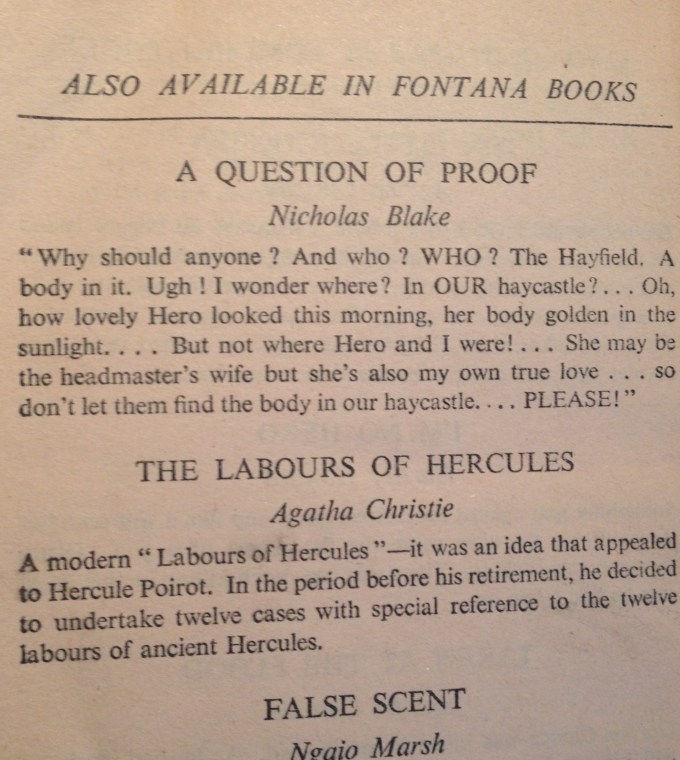
The “Also available …” section at the back of these books is often entertaining, and this one included a somewhat hysterical extract from A Question of Proof by Nicholas Blake. Blake was the pseudonym of Cecil Day Lewis, poet laureate, father of actor Daniel and an unlikely author for a paragraph such as this.

WHAT HAPPENED NEXT 
This is the book with which Agatha Christie came of age as a crime novelist of moment. It was also the one current at the time that she disappeared for 11 days, sparking off a manhunt and a huge amount of publicity, something that aroused the (unfair) suspicions of Sir Arthur Conan Doyle among others as to her motives.

Within a couple of years, the character of Caroline Sheppard had been transformed by Agatha Christie into that of Miss Marple, with the publication of The Thirteen Problems.

For the rest of the literary world, Ackroyd‘s publication sparked a controversy about the “fairness” of the plot that rages to this day. Among those contributing to the debate have been Roland Barthes, Umberto Eco and Raymond Chandler, plus myriad psychoanalysts and literature professors. One such was Professeur Pierre Bayard, whose book Who killed Roger Ackroyd? (“Qui a tué Roger Ackroyd?”) argued that during the case Poirot was suffering from delusions, that Sheppard was innocent and that his confession was made to protect the real culprit, his beloved sister…

It might sound absurd that the minds of the great should be troubled by a whodunit plot twist, but a discussion about what readers can know, and what they fill in for themselves when reading a book for the first time, is interesting in the context of any novel, and especially one like this that is narrated by a liar (by omission, as Sheppard is)*.

It should also be said that the American writer Edmund Wilson wrote an article in the New Yorker in the 1940s entitled “Who Cares Who Killed Roger Ackroyd?”

* For an absolutely brilliant example of  economical-with-the-truth narration, in various guises, Ian Pears’ An Instance of the Fingerpost is highly recommended.

ADAPTATIONS
The Murder of Roger Ackroyd was the first swigatha to be turned into a play (“Alibi”). The original cast featured Charles Laughton as Hercule Poirot; he later appeared, memorably, as Counsel for the Defence in the film version of one of her own plays, The Witness for the Prosecution. Another version of this is currently (2016) being made.

There was a disappointing Granada TV adaptation in 2000 featuring the estimable David Suchet as Poirot. It reflected none of the charm or humour of the book, and changed the ending to involve Caroline Sheppard as a guilty party. Interestingly, Professeur Bayard’s book was published in the UK in 2000 – maybe the producers had read it…

Swigathas have sold as many copies in foreign languages as in English. There was a Russian film made in 2002: Neudatcha Poirot (“Poirot’s Failure”), of which I have only seen excerpts. The title is an interesting one – maybe the director had also read Bayard (or seen the ITV version)…

In 2007 Gilbert Adair wrote The Act of Roger Murgatroyd, which takes the role of the narrator to yet another level.. A good title if nothing else! And so it goes on, and so it will continue to do.

Swigatha Q&A

Who or what is a Swigatha?
Swigatha with a capital ‘S’ is short for Swigatha Whiskey, a child’s-play on the name of the writer Agatha Christie. A swigatha with a small ‘s’ is a specific type of pulp fiction written by Agatha Christie.

What is pulp fiction?
Pulp fiction was the name given to stories printed on paper produced by the wood-pulping process. Previously, the paper in books and other reading materials had been created from linen. Pulping enabled the cheaper mass-production of books to meet  the demand for escapist entertainment from the start of the 20th Century onwards, and particularly in the aftermath of WW1.

Chief among the achievements of this process was the creation of the original paperback, a reader-friendly combination of paper, print, font and binding that, properly-made, could withstand the attention of many readers. Such paperbacks have thus long been a mainstay of second-hand bookshops, with the result that they were for many years available at a price that an eleven year old might be able to afford.

What specifically is a swigatha then?
A swigatha is a cheap, well-produced second-hand paperback book, specifically one printed in the mid-to-late 1960’s by Fontana or Pan. Each book contains a detective story by Agatha Christie.

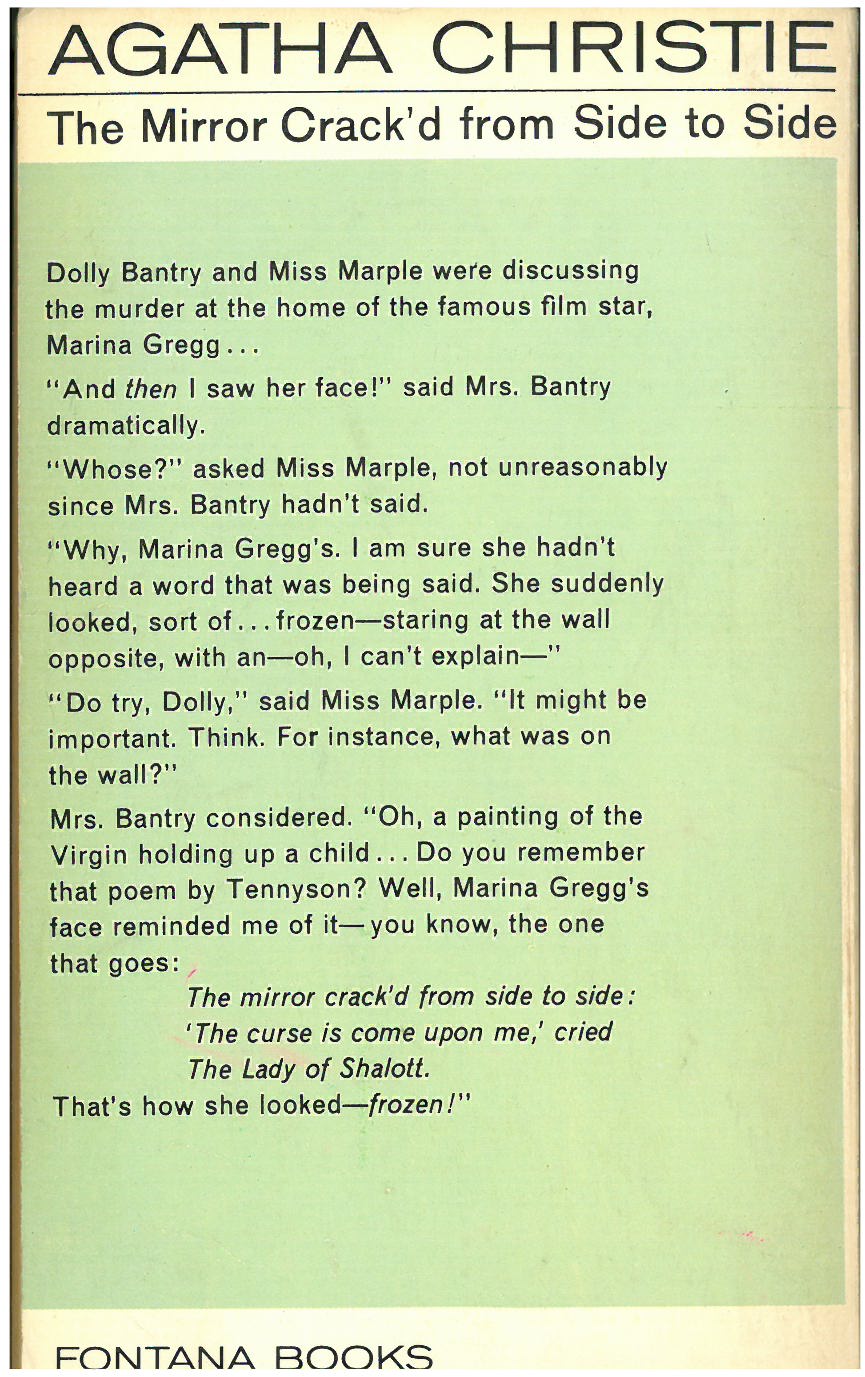
crackedf     crackedb

The Fontana books are characterised by a painting by Tom Adams on the front, topped and tailed by white strips with the name of the author and title in a particular font, one which differs from the text inside. That text is usually about 192 pages long. The books are priced 3/6.

Pan books usually display a photograph of some of the clues with the title on top. If the story features Hercule Poirot it is announced on the cover (but not if it features Jane Marple). The price is usually 4/- and the back cover features a monochrome photo of Swigatha.

linksback1       links22

I think these books are beautiful. Some seventy or so of Christie’s whodunits appeared in either one, or both, of these editions. Some of them are now extremely difficult to get hold of, and I am hoping that http://www.swigatha.com and this blog will help fill the gaps in my collection…

What about the books that were not published until after the 1960s, or the editions produced before then?
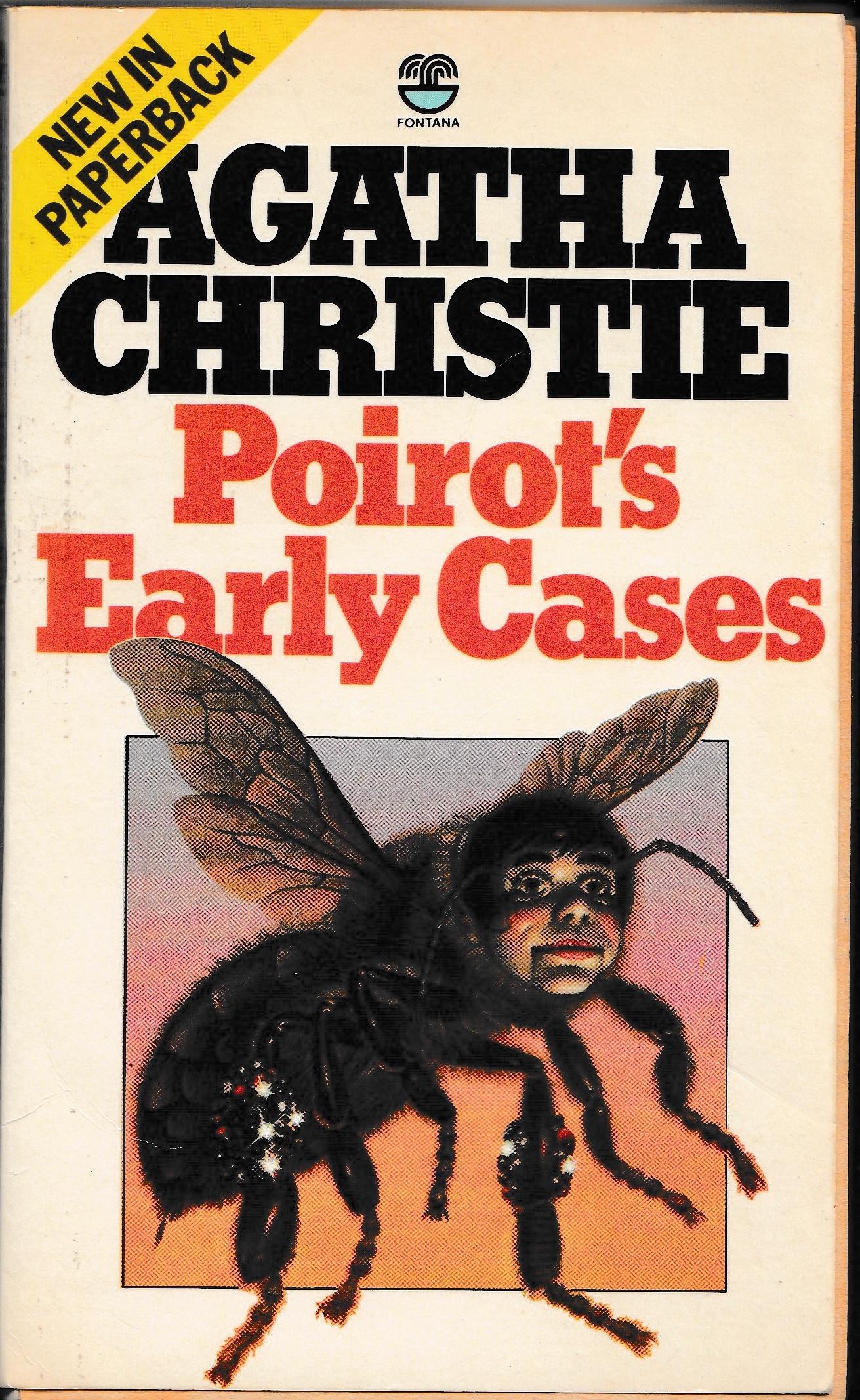
Professors of literature and philosophy will long debate whether the post-1969 paperbacks of Agatha Christie’s late novels, or the 1930-50’s editions of her earlier ones should not also qualify as swigathas – here are a couple of pictures of Fontana editions that may help their thought processes:

1979:                                               1958:

early-cases-front   7dialsf

And here is the condition of the book produced in 1979:

img_4869

It’s only been read twice.

Surely there is more to a swigatha than how the book was produced?
There is. The content of the stories and the style in which they were written are also quite important, plus the fun of reading them, the humour, the suspense, the puzzles, the throwaway quotations from Shakespeare and the Victorian poets, the bizarre French expressions employed by Poirot, the pharmaceutical know-how and in-depth knowledge of the ancient Middle East – all these define swigatha, because Agatha Christie has thrown so much of herself into it.

As with every book, there is the unique element of the reader, and the time and location when a book is first read. Most readers silently narrate the words to themselves when reading, and will hear and see the characters differently to other readers. An 11 year old on holiday in Brighton would not see and hear the same things that a 61 year old at home might.

Many swigathas already have a narrator. Thus the reader is actually playing the part of a character-narrator such as Captain Hastings or Dr Sheppard, potentially adding something of their own to a book that the author would not have imagined. Some French professors of literature and philosophy were so outraged when they found out that they had been playing the part of the murderer (i.e. Sheppard) when reading The Murder of Roger Ackroyd that a book was produced by one of them to prove it was actually someone else who dun it!

Just as a work of art is not finished until it has been exhibited, a book is not complete until it has been read, or, as Vladimir Nabokov would say, re-read.

What has the eleven-year-old go to do with it?
Well, I was eleven when I first read Sparkling Cyanide. It is the perfect age to pick up your first swigatha. Everything about it, from the cover to the contents, was completely new and fresh and made an impression on an impressionable child. I have since found that many of the people who treasure Agatha Christie’s work as adults also say that they first came across her books, second-hand, between the ages of 11 and 14. The swigatha package is one that can hook young adolescents and make them want to read more of them. This can instil a love of books and lead to other types of reading and areas of interest. In my case, it led indirectly to a love of languages, the ability and wish to memorise Shakespeare and the desire to write a swigatha of my own (which I did, with a friend, when I was 14 and was growing  out of hers). It also led to Dostoevsky…

Re-reading old swigathas as an adult made me finally realise that a book is far more than the words within it, thus opening up a whole new world to explore, of which this blog is a part.

What is www.swigatha.com?
www.swigatha.com will be a website that will review each of Agatha Christie’s stories as a swigatha, i.e. the whole book rather than just the story within its pages. It will also look at adaptations of the stories for TV, film and elsewhere. Other elements will include a Swigipedia and a general knowledge Swigword.

And this blog?
This blog will feature short essays discussing some of the less obvious elements of Agatha Christie’s work and that of others that her writing led me to. Planned features (though I’ll need to check they haven’t been covered already) include

  • Cover Versions – Pan and Fontana paperbacks 1963-1970
  • Poirot’s use of French in Death on the Nile
  • Three Interrogations – Jesus, Jesus and Karla
  • Dead and Gone, Lady – Christie’s use of quotations
  • “If you never read another one, read this one!”

It will also signal to the outside world via the swigatha facebook page @swigatha when the website is live and when new pages are added to it.

Peter Sheeran

References:

Prof. P Bayard: “Who Really Murdered Roger Ackroyd?” (Qui a tué Roger Ackroyd?)
V Nabokov : “You do not read a book, you re-read it”.

The quote on the side panel is taken from “Why be happy when you can be normal?” by Jeanette Winterson