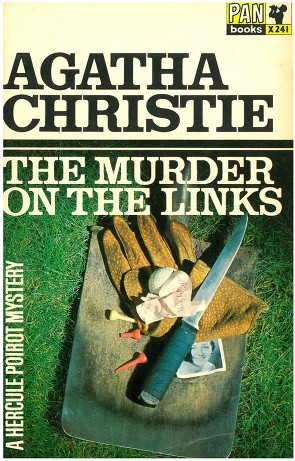


THE BOOK PAN, 1967 pp 220
The book, still in beautiful condition, has a fine cover which references some of the story’s clues: one of the daggers, Paul Renauld’s letter, Bella’s photo and the spade to dig the grave. The golf references – glove, tees and ball – are not relevant to the story but may help to define “links” for those not in the know, or German speakers who think that the murder was committed on the left.
On the backcover: “One can see by his face that he was stabbed in the back”, said Poirot – who would not want to read on?
The previous PAN edition from 1960 is one of their better ones, with a more plausible-looking Poirot (at least facially) than was sometimes the case. Why he would be wearing a dinner-jacket whilst hunting for clues escapes me.
THE STORY
Poirot and Hastings are summoned to France by Paul Renauld, who writes that his life is in danger. When they arrive at the Villa Geneviève they find out that he has been murdered. To the consternation of M. Giraud, the detective assigned by the Sûreté to lead the investigation, they decide to conduct one of their own.
A good setting and title – substitute the words ‘Golf Course’ for ‘Links’ and marvel at the difference.
CHARACTERS
Poirot battles with Inspector Giraud as much as with the case itself: they even have a bet on the outcome.
The principal characters in this story are Hastings and ‘Cinderella’, a young girl he meets swearing on a train, and with whom he falls in love. Note that Poirot had foreseen this: in the last line of The Mysterious Affair at Styles, he consoles Hastings, who has failed to woo two auburn-haired lovelies, thus:
“Never mind. Console yourself my friend. We may hunt together again, who knows? And then -“
Hastings (who himself must be at least in his 30s) judges that Cinderella is “little more than seventeen”. Even so, she surprises some unexpected depths in the good Captain. It reminded me a bit of another Captain: Mainwaring, who is (briefly) transformed when he falls for another woman during the ‘Brief Encounter’ episode of Dad’s Army.
Overall, the main characters are incredibly suspicious of each other:
– Hastings is convinced that Cinderella is Bella Duveen and that she killed Paul Renauld
– Cinderella is convinced that Bella (her sister) killed Paul Renauld
– Bella is convinced that Jack Renauld killed Paul Renauld
– Jack is convinced that Bella killed Paul Renauld
As ever, the actual murderer is just about the only character that no-one suspects.
This was the first of Swigatha’s books to be set in France. The local characters here are treated with more respect than she sometimes permitted herself when adding local ‘colour’ to stories set in England, and this was to continue to be the case. No matter whether the stories were set in the Middle East, South Africa, the Caribbean or the Balkans, you will never find a local character evincing a shred of the fatuity personified by the retired Colonels, politicians, medical profession and seedy gentry during the stories based in England.
QUOTES
Poirot’s unique (and humorous) French language style develops:
“Some of the greatest criminals I have known had the faces of angels”, remarked Poirot cheerfully. “A malformation of the grey cells may coincide quite easily with the face of a Madonna.”
“Poirot”, I cried, horrified, “you cannot mean that you suspect an innocent child like this!”
“Ta ta ta! Do not excite yourself! …”
Here he is, admonishing the household of the Villa Geneviève:
“You are an old woman completely imbecile! And Léonie and Denise are no better. All of you are triple idiots!”
SWIGATHA RATING 6/10
In many ways, it is a rattling good yarn, especially for an eleven-year old to read, but the plot can withstand little scrutiny. Rarely can so many individuals have decided to wander around a golf course at midnight!
WHAT HAPPENED NEXT
Christie packed Hastings off to the Argentine with his wife-to-be, possibly to join her sister and Jack Renauld on a ranch. Every few years, Hastings will return to London “for business reasons”, then promptly forget them and join Poirot on cases such as Peril at End House and The ABC Murders.
Hastings’ final return (and appearance) comes in Curtain, when he retires to England after Cinderella’s early death.
Christie herself returned to France for The Kidnapped Prime Minister, in her first set of short stories, and then again in The Mystery of the Blue Train soon afterwards.
ADAPTATIONS
ITV’s Poirot series adaptation was very close to the original, apart from excluding the future Mrs Hastings’ twin sister (much the best thing to do). It is quite amusing, especially in the exchanges between Poirot and Giraud, and Chris Gunning has great fun frenchifying his theme tune
PERSONAL NOTE
When I was 11, I shared a bedroom with 5 younger siblings. After lights out, I used to tell them a whodunit-type story featuring a crime committed by “The Ghostly Horror”. Just to settle them down, you understand – they were between 5 and 9 years old. The suspects were always the same. with names like Willie Stealit and Ima Gangster.
Before revealing who-did-it, and letting them get to sleep, I got them to say who they thought the baddie might be. I then chose the character that no-one had mentioned.
I think I must have been reading Murder on the Links (and the Beano) at the time. Later, at 14, my great friend David Hatton and I collaborated on our own swigatha (The Little Dog Laughed), and included ‘One can see by his face that he was stabbed in the back’ in the text. So, definitely influenced!
 Swigatha