
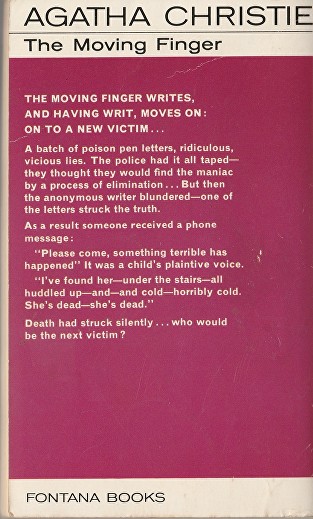
THE BOOK Fontana 1969 pp 160
In my opinion, this is Tom Adams’ finest cover. The pestle and glass refer to two of the means used during the murders of Mrs Symington and her maid, but the beautifully produced parchment – some kind of legal document – does not directly refer to anything in the book.
Adams said1 that the painting actually contains an extra clue, but did not reveal it; I would guess that it would be the parchment’s hint of the involvement of a solicitor and maybe the tear in it. A torn piece of paper is all Miss Marple needs to work out who the culprit was.
The peak-period Fontana Agatha Christie paperbacks of the 1960s usually amounted to around 192 pages, so this is one of her shorter ones.
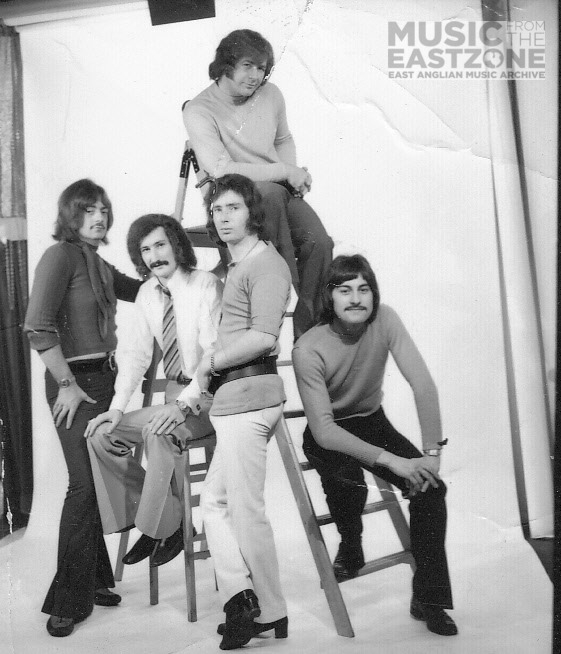
The Moving Finger was also an (unsuccessful) Norwich band in the late 1960s.
THE STORY
A wounded WWII pilot and his sister move to the village of Lymstock in a bid to speed his recovery. They soon receive an anonymous letter accusing them of not being siblings, and discover that many other people in the village have had similar. Death follows.
The vicar’s wife calls in Miss Marple …
THE TITLE
It is taken from the first English translation of The Rubaiyyat of Omar Khayyam:
The moving finger writes, and, having writ, moves on;
Nor all thy Piety nor Wit
Shall lure it back to cancel half a Line,
Nor all thy Tears wash out a Word of it
The implication is that, once an accusation has been made, it will stick no matter what you do (a constant expression used throughout the story is “no smoke without fire”). The twist here is that all the accusations are false. Maybe Agatha Christie was anticipating the calumnies of today’s social media, which can never be wiped.
CHARACTERS
Although it has a typical village setting, there is quite a variety of character on display in this book: the fierce Maud Dane Calthrop and her remote husband Caleb, the ‘extremely lady-like plump little Mr Pye’, the bland Miss Holland, the frustrated feminist Miss Griffith, the distrait Megan and the disapproving Partridge. Some very interesting ideas are expressed. The only person without any real character traits is the murderer.
ATTITUDES AND QUOTES
Many of the attitudes expressed are, I suspect, close to those of Agatha Christie herself (see the quotes below). When she re-read some of her books some 20 years later, she found that this was one that she was very pleased with – maybe because there was more of her in it than usual.
Mr Pye:
I do believe in atmosphere, you know. People’s thoughts and feelings. They give their impression to the walls and the furniture.
James Burton, the narrator:
I have never been able to accept that education is the panacea for every ill.
“It is a theory of mine,” I said, warming to my theme, “that we owe most of our great inventions and most of the achievements of genius to idleness – whether enforced or voluntary. The human mind prefers to be spoon-fed with the thoughts of others, but deprived of such nourishment it will reluctantly begin to think for itself …”
Aimée Griffith:
“It is incredible to you that women should want a career. It was incredible to my parents. I was anxious to study for a doctor. They would not hear of paying the fees. But they paid them readily for Owen. Yet I should have made a better doctor than my brother.”
Miss Marple is severe:
“Yes, it was dangerous, but we are not put into this world, Mr Burton, to avoid danger when an innocent fellow-creature’s life is at stake. You understand me?”
SWIGATHA RATING 7/10
It scores well for the excellent simplicity of its plot: a series of poison-pen letters provides a smoke-screen to hide what would otherwise have been pretty obvious.
And it really is obvious: a solicitor lives with a neurotic wife and a beautiful governess; the two people murdered are killed in his house; the typewriter used for the envelopes had been owned by him and donated to the Women’s Institute … and so on. And yet I would bet that most people would not fix on him as the killer. Very clever.
Miss Marple appears to have been brought in as an after-thought, however, and the ploy used to trap the killer is as ridiculous as the similar ones used in The Murder t the Vicarage, The Body in the Library, A Murder is Announced and A Caribbean Mystery.
WHAT HAPPENED NEXT
Miss Marple disappeared for seven years, before making a triumphant return in A Murder is Announced. In 1961, the Rev and Mrs Dane Calthrop re-appeared, strangely, in The Pale Horse, as part of a detective super-group, alongside Rhoda and Colonel Despard and Swigatha’s alter-ego Ariadne Oliver (the three of whom met in Cards on the Table).
ADAPTATIONS
BBC, 1985: another of the Hickson Marples. This is a faithful adaptation, apart from giving Miss Marple a much greater role than she has in the book. For some strange reason, some of the names are changed: the village of Lymstock becomes Lymston, and Aimée Griffiths is re-named Eryl. The actors all look the part, although some are not quite up to playing it…

Gordon Rollings, Patsy Smart

Penelope Lee, Juliet Waley, Michael Culver
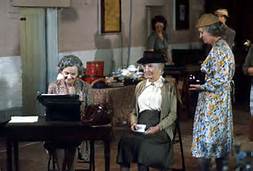
Dilys Hamlett, Joan Hickson
There was also an ITV production starring Geraldine McEwan …
NOTES
1 Tom Adams Agatha Christie Cover Story: Adams commentates on his own paintings, with additional comments from the detective fiction writer Julian Symons
 Swigatha