

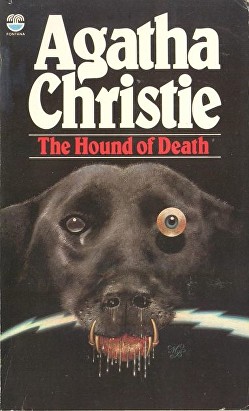
THE BOOK Fontana, 1976 pp 190
Tom Adams’ skull-and-crystal ball cover painting refers (obliquely) to the title story in this collection, in which a nun hallucinates about the ‘people of the crystal’. Because of the eye, I had always thought the crystal ball a monocle and the skull that of a Nazi. The book itself came apart on re-reading – so typical of mid-70s copies.
The later cover is a bit of a steal of Adams’ idea.
THE STORIES
These stories were mainly written in the 1920s and published in a variety of magazines in the UK. According to Robert Barnard, one of them, The Call of Wings, was written long before The Mysterious Affair at Styles, i.e. before the First World War. 1
Apart from the central story, The Witness for the Prosecution, most of the stories concern the supernatural – there are two seances, four possessions of the soul by an intruder soul, alongside ghostly apparitions and visions of heaven.
There is one story that might have strayed out of The Listerdale Mystery; this is The Mystery of the Blue Jar, in which a gormless young halfwit playing golf is deceived into handing over a priceless antique to a pair of crooks, but most are much of a muchness plot-wise.
CHARACTERS
There are plenty of medical men of a charlatanic ilk:
Dr Rose, researching medical disorders (The Hound of Death)
Sir Alington West, the ‘supreme authority on mental disease’ (The Red Signal)
Dr Campbell Clark, renowned physician and mental specialist (The Fourth Man)
Dr Meynell, who liked attending rich patients (Wireless)
Ambrose Lavington, ‘Doctor of the Soul’ (The Mystery of the Blue Jar)
Dr Carstairs, eminent psychologist (The Strange Case of Sir Arthur Carmichael)
Dr Seldon, nerve specialist (The Call of Wings)
Mortimer Cleveland, expert on the subconscious and member of the Psychical Research Society (The Call of Wings)
Agatha Christie never really trusted doctors: ’nuff said!
Among their ‘patients’ are a nun, who is able to coax supernatural powers to destroy a First World War German Army unit that is occupying her convent; a man who is possessed by a cat, is drowned, and then brought back to life, catless; and a man, inspired by the music of a down-and-out, who gives away all his money and sacrifices himself to save a drunken youth who has fallen on to an underground railway track. These stories are, at least, different.
ATTITUDES AND QUOTES
From the title story, a theme returned to often in the other stories:
The supernatural is only the natural of which the laws are not understood.
There is one quote that recalls Agatha Christie’s recurring childhood nightmare featuring The Gunman, who would turn up during normal family occasions and assume the character of one of her family members: 2
It all started with a dream I had as a kid. Not a nightmare exactly. She – the gypsy – would just come into any old dream – even a good dream (or a kid’s version of what’s good – a party and crackers and things). I’d be enjoying myself no end, and then I’d feel I’d know that, if I looked up, she’d be there, standing as she always stood, watching me … (The Gypsy)
SWIGATHA RATING 5/10
The Hound of Death doesn’t work as a collection, unlike, for example, The Mysterious Mr Quin, The Thirteen Problems or The Labours of Hercules, each of which contains one story that establishes the context, with the others following on from it.
In my opinion, one or two of these stories, including the title story, are not worthy of publication. So it came as no surprise to discover that the original collection had not been published by Collins, her regular publisher, nor was it available in the shops: to get hold of a copy one had to collect coupons from a magazine.
Most of the individual stories are, however, at least interesting or entertaining and, if one came across one of them in a magazine, one might be delighted.
But in Witness for the Prosecution, Agatha Christie has provided an absolute classic of the genre, and one that would prove to be very lucrative for her.
WHERE IT LED
Nowhere, thankfully, with one blazing exception (see below). Agatha Christie included many of these stories in one of her ‘favourites’ lists, but not many readers would do likewise.
ADAPTATIONS
Unsurprisingly, given the content, there have not been many, but three of the stories were filmed for The Agatha Christie Hour – The Red Signal, The Fourth Man, and The Mystery of the Blue Jar. The Red Signal was also filmed for US TV in the 50s and is on YouTube.
Witness for the Prosecution was adapted into a stage play in the 1950s by the author. It was a huge success and is still performed all over the world. A new production, which invites members of the public to play the jury, opened in London 2017 and has also been a great hit. The 1957 Billy Wilder film of the play, starring Charles Laughton and Marlene Dietrich, remains the finest cinematic adaptation of any Agatha Christie work yet.
By contrast, the risible BBC version from 2016 ranks amongst the worst adaptation of any description, because it ripped apart the original and left it unrecognisable.
NOTES
1 Robert Barnard A Talent to Deceive (1980): Barnard indicated that in his opinion The Call of Wings was ‘the best of the rest’ (i.e. after Witness)
2 Agatha Christie An Autobiography (Part 1 Chapter 4)
 Swigatha