
THE BOOK Fontana 1967 191pp
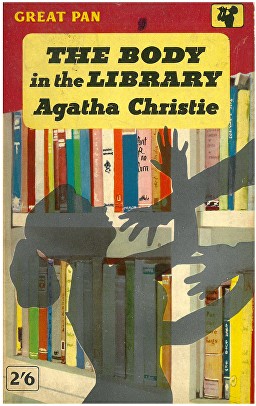
Tom Adams’ painting hints at, rather than points to, some of the elements of the plot: a dead girl’s made-up nails, a rug like the one used to wrap and transport her to the library and the spangled dress she may have worn while dancing that evening. It also contains an insect very similar to the ones adorning his cover of The Murder of Roger Ackroyd.
THE STORY
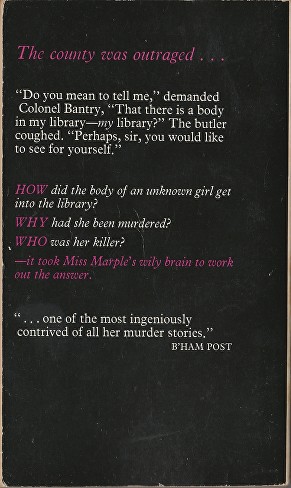
Early one morning, Colonel and Mrs Bantry are woken by their maid, who tells them that she has found a young girl’s body in their library at Gossington Hall. Tongues begin to wag in St Mary Mead when no explanation can be found for its presence there. Mrs Bantry enlists the aid of her neighbour Jane Marple in her efforts to find one.
The idea of a dead body being found in the library of a mansion or country house was already as big a cliché in the 1930s as that of the butler being the guilty party. Agatha Christie had been toying with the idea of the library-as-scene-of-the-crime for a while, and settled on making the body’s presence as incongruous as possible.
CHARACTERS
The characters who inhabit St Mary Mead and its environs are colourfully drawn – the Bantrys, the Blakes and the local gossips. The members of the party staying at the seaside hotel where the dead girl worked, on the other hand, are mostly unmemorable and not very likeable, in particular Conway Jefferson, a dirty old rich man wanting to adopt an 18-year-old dancer who flattered him.
My favourite character is that of the tennis-pro-cum-gigolo, Raymond Starr, who is desperate to break free of his role. He re-invents himself as “one of the Devonshire Starrs” in an attempt to attract Jefferson’s son’s widow.
ATTITUDES
No-one seems to have any pity or sympathy for an 18-year-old girl who has been murdered far from home, with the exception of Miss Marple. No-one seems outraged that a drunken man, on finding the dead body of what proves to be a 16-year-old girl guide, should pile it into his car and dump it in someone else’s house; not even the house-owner.
Basil Blake mentions “that filthy brute, Rosenberg”. Anti-semitism alert … Rosenberg here, however, is a “disgusting Central European”, rather than a fleshy-nosed person, as might have been the case in earlier stories.
QUOTES
Miss Marple is on great form; here are some classic quotes, variations of which appear in many of the stories featuring her. The strange thing is, one never tires of reading them, or indeed hearing them (when intoned by Joan Hickson):
‘I must say’, said Sir Henry ruefully, ‘that I resent the way you reduce us all to a general common denominator.’
Miss Marple shook her head sadly. ‘Human nature is much the same anywhere, Sir Henry.’
Miss Marple made a contribution to the conversation. ‘Gentlemen’, she said, with her old-maid’s way of referring to the opposite sex as though it were a species of wild animal, ‘are frequently not as level-headed as they seem.’
‘Married people, I have noticed, quite enjoy their battles and the – er – appropriate reconciliations.’ She paused, twinkling benignly.
‘Well, I – ‘ Dinah stopped and laughed. She sat down and lit a cigarette. ‘You’re absolutely marvellous!’ she said.
Here, Mark Gaskell quotes Wordsworth’s lament for ‘Lucy’ as he reacts delightedly to the death of Ruby Keene:
But she is in her grave and oh! the difference to me!
Christie had already used exactly the same quote, and the relief that it encapsulates, a couple of years earlier (in Sad Cypress).
Here, Colonel Melchett slaps down his Inspector when they are trying to work out whose body is in the library and Slack is telling him that there is a 16-year-old girl missing:
Don’t go on reading idiotic details, Slack. This wasn’t a schoolgirl.
Well, actually, Colonel, it was. Now Mrs Bantry and Miss Marple view the body:
She said at last in a gentle voice: ‘She’s very young.’
‘Yes – yes – I suppose she is.’
Mrs Bantry seemed almost surprised – like one making a discovery.
This reaction of the principal magistrate of the district to the discovery, removal and dumping of a young girl’s body is singular:
‘Bottled, was he?’ said Colonel Bantry, with an Englishman’s sympathy for alcoholic excess. ‘Oh well, can’t judge a fellow by what he does when he’s drunk.’
SWIGATHA RATING 7/10
The book has an excellent beginning (Swigatha considered it her best). It is sometimes difficult to realise now how original her plotting was. This is in part because she herself kept re-using bits of it!1
Because Miss Marple arrives at her solution, as usual, through pure reasoning rather than any actual evidence, she yet again has to stage a drama to ‘smoke ’em out’. This became something of a feature of her stories.2
WHAT HAPPENED NEXT
This was the first Miss Marple novel for twelve years. It was a huge success, establishing her as one of the great characters of detective fiction. Fans didn’t have long to wait for the next one – The Moving Finger, in 1943.
Colonel and Mrs Bantry continued to live happily at Gossington Hall until his death, whereupon she sold the house to a famous Hollywood actress (although she continued to live in the grounds).
ADAPTATIONS
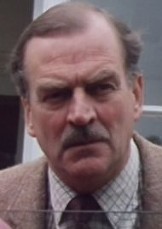
BBC, 1984. The first film to be produced in the Hickson Marples, and a good start, if rather a bit too heavy with the isn’t-she-marvellous stuff. I suppose that was necessary to underline the fluffy old lady’s status as master-detective to a new audience. Good cast including Moray Watson, excellent as Bantry, and the wonderful David Horovitch as Slack.


There was also a somewhat lamentable version made by ITV in 2004, also the first in the Agatha Christie’s Miss Marple series, featuring Geraldine McEwan. This laid responsibility for the murders at the door of two lesbians, and implied that Miss Marple had never got over the death of her lover on the field of battle in WW1. It did at least, however, make it clear that the perpetrators uncovered by Miss Marple would be hanged.
NOTES
1 In Nemesis, for example, two young girls are also murdered: one is disfigured and deliberately mis-identified by her killer, and the other the object of inappropriate attention from someone much older.
2 Variations on this ploy can be found in The Murder at the Vicarage, The Moving Finger, A Murder is Announced, 4.50 from Paddington and A Caribbean Mystery.
 Swigatha