
THE BOOK Fontana 1992 pp ‘227’
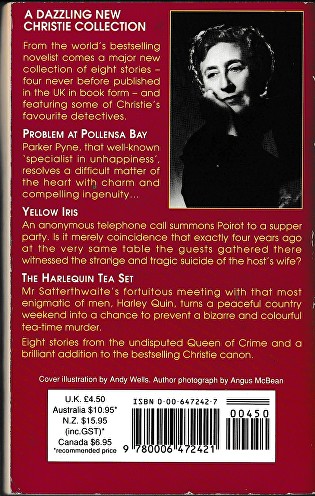
A rather pitiful Fontana cover (oh, for Tom Adams!) presumably features elements of some of these stories – for example, a champagne glass from Yellow Iris – but I am blowed if I know what the rest are. The back cover mentions three of the stories that feature stalwart Christie characters, but gives no indication of the two that don’t.
These stories were written between 1925 and 1971. A typical AC paperback from 1971 would have had 40 lines on a page. This similarly-sized 1992 paperback has 30, so if these stories had been published in a collection at the time when the last of them was written (and Agatha Christie was alive), the book would have been 55 pages shorter.
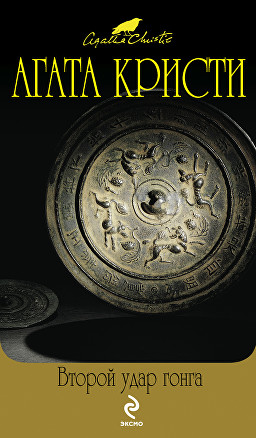
The far more classy cover on the right is for a Russion electronic book: it features the gong in The Second Gong (or, as the Russian translation has it, ‘The Second Bong of the Gong‘).
THE STORIES
There are eight stories in this collection: two feature Parker Pyne, two Hercule Poirot and two Harley Quin. Reading them now, one cannot but help think that one has read many of them before.
Problem at Pollensa Bay (first published in 1936)
In which Parker Pyne resolves a mother’s fears for her son’s future with the help of Madeleine de Sara, aka Dolores Ramona, aka Maggie Sayers, whom the mother condemns thus: ‘The creature’s a Dago.’ Madeleine had performed a similar role in The Case of the Discontented Soldier, from Parker Pyne Investigates.
The Second Gong (1932)
Hercule Poirot is hired by a man who thinks he is being swindled. He travels to the man’s home only to find that he has been killed by the time he arrives. Basically the same plot as Dead Man’s Mirror, one of the stories from The Murder in the Mews.
Yellow Iris (1937)
Hercule Poirot receives a mysterious phone call begging him to come to a restaurant late at night to prevent a murder. He manages to do so. The basic plot of this story is fleshed out in the later novel Sparkling Cyanide, apart from the presence of Poirot, which might explain why the murder attempt in that story is successful.
The Harlequin Tea Set (1971)
Mr Satterthwaite’s car breaks down (again! see At The Bells And Motley, from The Mysterious Mr Quin) and he repairs to a café where he meets Harley Quin. Lots of references to red hair, dark skin and genetic inheritance (not for the first time) and a fatuous plot line about a mother switching her one year old son and her one year old stepson around, and the father of the stepson not noticing.
The Regatta Mystery (1936)
Clever-ish nothing of a romp concerning an expensive jewel being stolen in plain sight. When first published, it featured Hercule Poirot; here it has Parker Pyne.
The Love Detectives (1950)
Satterthwaite has car problems (again). The one in which he is travelling to a crime scene, as guest of the Chief Constable of the district, is pranged by one being driven by Harley Quin. Somewhat incredibly, Quin is then asked to hop in and also attend the scene by Colonel Melrose, the said Chief Constable. Sadly, the plot provides another example where two people who connived at a murder individually admit to it, both implausibly.1
Next to a Dog (1929)
A young girl at her wits’ end looking for work finds her only comfort in the person of her ageing terrier, Terry. When Terry has an accident and is put down, her outlook improves. Slightly nauseating, but an interesting insight to the plight of young women in general, and especially young widows, after WW1, a subject to which Agatha Christie returned often in her early short stories.
Magnolia Blossom (1925)
A woman is persuaded by her desperate, ne’er-do-well husband to ‘present herself nicely’ to another man, one with whom she had in any case been planning to run away. Not one of Swigatha’s finest twists.
SWIGATHA RATING 3/10
Most of these stories are ok individually as a light read, but putting them out as a collection is not. Nowadays, of course, if they come across a really good and hitherto unknown story by her, it could just go out in electronic format, indeed as the Russian version of The Second Gong did.
Strictly speaking, Problem at Pollensa Bay does not come within the original ‘swigatha’ remit2, because the book did not come out until I was in my thirties. It is included for the sake of completeness; if one were to be kind to the Christie Estate, one would say that it was published for the same reason.
WHAT HAPPENED NEXT
What happened next was an ongoing rummage through the Christie archives for further stories with which to entice her growing global readership. So, in 1997, we had the desperately weak collection While the Light Lasts, which the author would have been horrified to see published. Since then there have been different versions of Dumb Witness, Dead Man’s Folly and The Case of the Caretaker published. None is an improvement on what was originally published.
So, what also happened next was the closure of the swigatha files – enough!
ADAPTATIONS
Yellow Iris was adapted for TV by Granada as part of their Poirot series.
NOTES
1 Compare and contrast The Murder at the Vicarage. They even use the tampered-with clock idea again as well
2 The original idea was to re-visit all the Agatha Christie books I read as a child and teenager, in the editions that I read, and compare the impact of the books now with what I remembered from then.
 Swigatha