
THE BOOK PAN, 1969 pp 192
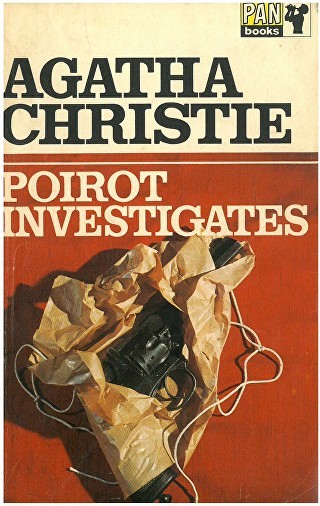
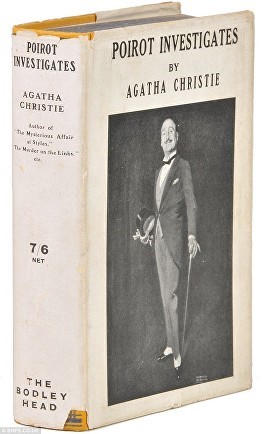
The PAN edition which I read has a nice cover but an image that has no relevance to any of the stories in the book. The hardback cover is from a first edition in 1924 – one of these sold for ₤40,000 in 2018.
THE STORIES
There are eleven stories in this collection. All had been published in The Sketch magazine, whose editor, Bruce Ingram, had originally suggested that Agatha Christie have a go at writing short stories featuring Poirot and Hastings.
The Adventure of the Western Star
Poirot investigates the robbery of an exotic jewel, apparently perpetrated by ‘a Chink’. Written at a time when apparently all Chinamen wore pigtails. PC note: the person who refers to ‘the Chink’, as is often the case in Agatha Christie’s stories when someone disparages people of another race, turns out to be the culprit.
The Tragedy at Marston Manor
Poirot investigates an apparent natural death on behalf of an insurance company. Not up to standard.
The Adventure of the Cheap Flat
Friends of Hastings are offered an in-demand flat for a pittance because of their surname. Very Conan Doyle in concept, and very Holmes and Watson in action.
The Mystery of Hunter’s Lodge
Poirot sends Hastings to investigate a murder in the Midlands as he himself is unwell. Hastings reports back his findings and Poirot miraculously solves the case. The murderers get away with it, though.
The Million Dollar Bond Robbery
A million dollars in bearer bonds disappears as it is transported across the Atlantic to New York. For once in this collection, Poirot’s deduction is undeniable; all the clues were there.
The Adventure of the Egyptian Tomb
The curse of the mummy’s tomb, a story churned out hard on the heels of the 1922 Tutankhamun discoveries. The story has a bit more to it than most in this collection, and also has an early example in Christie of the solution being ‘hushed up’ afterwards (until, of course, Hastings’ narrative emerges!)
The Jewel Robbery at the Grand Metropolitan
A simple tale of servants at a Brighton hotel and their activities (or lack of them). A jewel is stolen from under the nose of one of them.
The Kidnapped Prime Minister
Poirot at his best. Set an impossible task – to find a man kidnapped between London and Paris within twenty-four (and a quarter) hours – he abandons the hopeless chase and uses the famed grey cells to work out what had happened. An example of Agatha Christie directing the readers’ attention in a particular direction by playing on her assumptions of their prejudices (with the inclusion as a suspect of O’Murphy from County Clare – this story was written at the time of the Irish battle for independence).
The Disappearance of Mr Davenheim
An early example of one of Swigatha’s brilliant solutions: in this case, the answer to this riddle: ‘Where is the best place to hide from the police?’
The Adventure of the Italian Nobleman
Unconvincing in the extreme. Poirot solves a case based on the fact that the victim must have drunk some coffee.
The Case of the Missing Will
A slight, but enjoyable tale in which Poirot pits his wits against those of a dead man.
SWIGATHA RATING 4/10
This is a weak collection, which is understandable as these stories are Agatha Christie’s first essays in the art. Most of the entertainment is provided by the interaction between Hastings and Poirot, rather than the stories themselves. There are, at least, a couple of ideas that hint at the genius of her plotting that was to come.
Re-reading them today was frankly, boring to me. What irony, then, that these stories, slight though they may be, led indirectly to a huge new global audience for the works of Agatha Christie.
WHAT HAPPENED NEXT
Hastings narrated a further 14 short stories, which were not collected and published for a further 50 years (Poirot’s Early Cases).
In the meantime, Agatha Christie tried her hand at a variety of collections featuring disparate main characters – Tommy and Tuppence, Miss Marple, Mr Quin, Parker Pyne – plus two sets of stories that in the main eschewed the detection element: The Hound of Death and The Listerdale Mystery.
Incredibly, all of these collections were published 1929-34 whilst she was also producing regular (and top-class) full length novels.
ADAPTATIONS
In 1989, ITV in the UK presented the first series of Agatha Christie’s Poirot. This was a series of one-hour programmes, each based on a short story, featuring David Suchet as Poirot and Hugh Fraser as Captain Hastings. It was a huge success, and encouraged ITV to continue. Further series ensued, until every short story had been covered, while its popularity grew and grew. By 1990, they had started making two-hour films of the novels; within twenty-five years every single Poirot story had been covered. No character in the history of literature has ever been so comprehensively and well-served (for the most part) on TV.
Some of the early stories (such as the ones above) are so slight that the ITV screenplays1 had to introduce extra elements to fill the hour allocated. The plots would (usually) be fundamentally the same, but with far more background added to the characters of the villain and other suspects. The most significant addition was the inclusion of the characters of Inspector Japp and Poirot’s secretary Miss Lemon in almost every one of these episodes2.
It proved to be a brilliant move: the characters of Poirot’s associates went far beyond what appears on the page and were hugely popular. Because ITV had started with these light short stories, rather than the heavier novels, the actors were given time and space to present their characters to the audience, who in turn took to them immediately.
These early adaptations were beautifully and carefully made. They attracted a huge following all over the world, and are still being shown, everywhere. There had been plenty of presentations of Poirot on screen, but never with side-kicks like these.
NOTES
1 Anthony Horowitz wrote the screenplay for a few of these episodes. He recently published Magpie Murders, an interestingly constructed book that has many, many references to Agatha Christie; the detective’s side-kick is even named Fraser, after the actor who played Hastings.
2 Miss Lemon and Captain Hastings never actually met in any of the original Poirot stories.
 Swigatha